The “Last Mile Risk” of Heavy-Duty Truck Power Systems
In heavy-duty truck power systems, traditional architectures typically use lead-acid batteries to perform two functions: starting power and handling the parking power load during extended periods of parking. With the increasing number of onboard 4G terminals, smart gateways, and household electrical devices, lead-acid batteries are highly susceptible to depletion after prolonged parking, preventing the vehicle from restarting and creating a typical heavy-duty truck battery drain problem.
In these scenarios, engineers must consider both the current capability for low-temperature starting and the remaining capacity and battery life after prolonged discharge, creating a near-impossible balance for the traditional lead-acid system.
Technical Root Causes
Structural Shortcomings of Lead-Acid Systems in Low Temperature and Cycle Life
For electronics and power engineers, the problem can be summarized in two points: ① Short cycle life: Lead-acid batteries rely on chemical reactions to store energy. Under deep charge-discharge conditions, active materials are easily shed, resulting in a typical cycle life of only 300–500 cycles. Frequent parking and frequent start-stop cycles significantly accelerate aging, forcing an earlier replacement of lead-acid batteries. ② Poor Low-Temperature Performance: In environments as low as -40℃, the internal resistance of lead-acid batteries increases significantly, and their discharge capacity drops sharply. Even if the State of Charge (SOC) appears acceptable, it cannot release a sufficient large current in a short time, causing engine start-up failure at low temperatures.
This means that a lead-acid system alone is unlikely to provide stable and predictable starting and parking load capabilities in extreme environments.
YMIN Solution
4G Intelligent Lithium Battery + YMIN Supercapacitor SDB Series “One-Click Strong Start” Architecture
YMIN Capacitors, targeting 4G intelligent lithium battery applications in heavy-duty trucks, has proposed a combined architecture of “power lithium battery + YMIN supercapacitor SDB series”: the lithium battery provides energy, and the supercapacitor provides power, forming a highly reliable one-click strong start module.
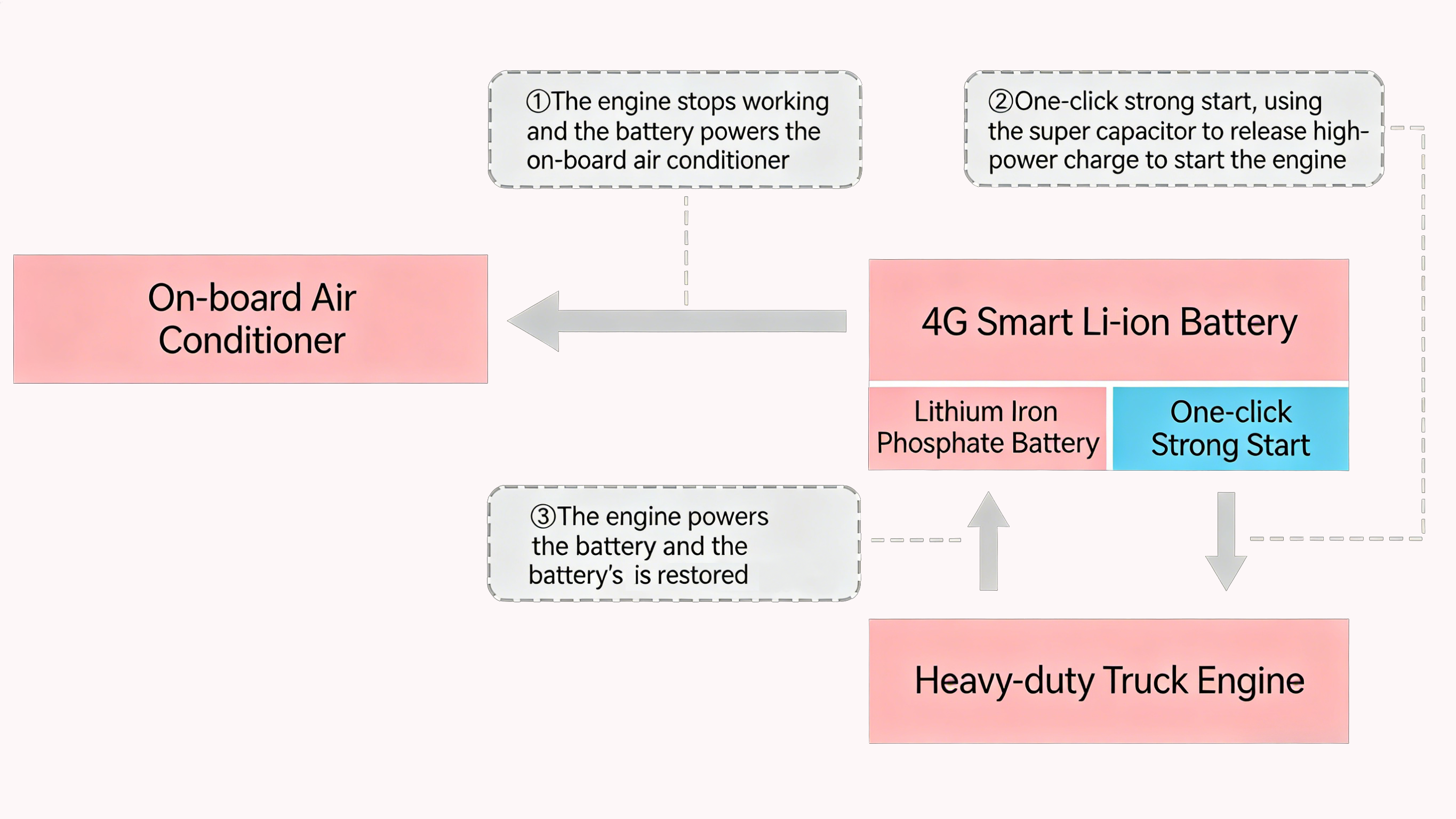
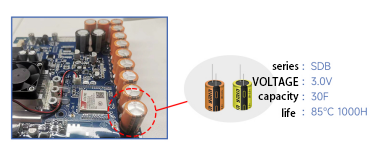
In terms of selection, automotive-grade capacitors such as SDB 3.0V 30F 16×25 are used as the basic unit to construct a one-button emergency start module for heavy-duty trucks. This module offers the following technical advantages: Ultra-high power density: SDB supercapacitors can output high-rate current in milliseconds, meeting the large current pulse required for engine cold starts, making them suitable as the core component of an “emergency starting power supply.” Long cycle life: Individual cell cycle life can reach 500,000 cycles, and the module-level cycle life exceeds 100,000 cycles, requiring almost no replacement throughout the vehicle’s entire lifespan, significantly superior to the 300-500 cycle level of lead-acid batteries. High and low temperature resistance: It maintains a low equivalent series resistance and outputs large current even at -40℃; it can operate stably for 1000 hours at 85℃, providing sufficient temperature margin for the engine compartment and chassis layout. High Voltage + Small Package: The 3.0V rated voltage helps engineers reduce the number of series links under the same system voltage. Combined with a 16×25 mm size, it significantly reduces module size, improves overall system energy density, and increases layout flexibility. High Safety and Automotive Certification: The product is AEC-Q200 certified and manufactured under the IATF16949 quality system, ensuring high safety. Even in the event of failure under extreme conditions such as over-temperature, over-voltage, and over-current, it will not ignite or explode, thus meeting the functional safety requirements of the entire vehicle.
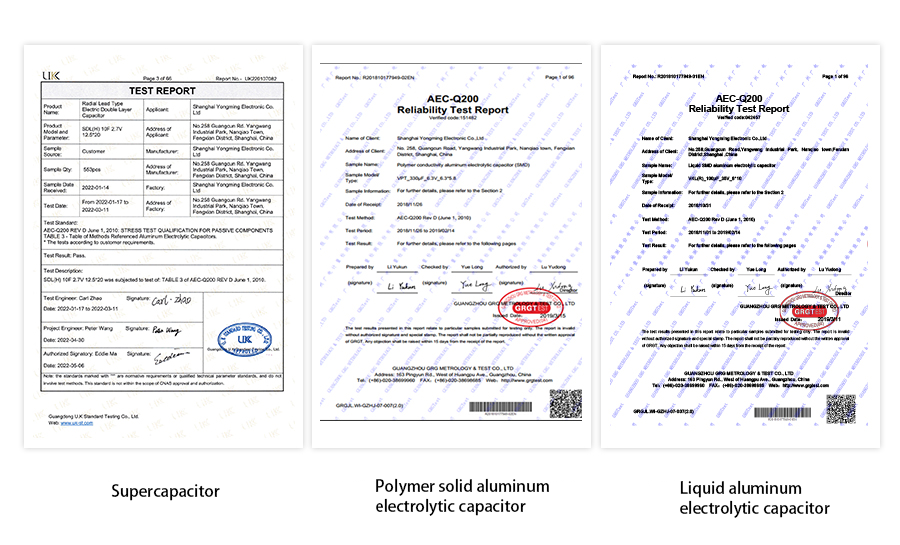
Data Verification & Selection Recommendation
From the perspective of test indicators, regarding “engineering availability,” in a heavy-duty truck customer’s 4G intelligent lithium battery project, the following verifications were completed based on the YMIN Supercapacitor SDB series emergency starter module:
① -40℃ Low-Temperature Start Test: Continuous testing in a -40℃ environmental chamber, with multiple triggers of the one-button forced start, achieved a 100% engine start success rate.
② 100,000-Cycle Test: Using a “charge-discharge-rest” cycle method, after completing 100,000 cycles, the capacitor capacity retention rate was >80%, still meeting the one-button forced start requirement.
③ System Lifetime and Cost Assessment: With a 10-year vehicle lifespan as the design target, integrating the YMIN Supercapacitor SDB series reduced system maintenance frequency by 80% and lowered the total lifecycle cost of the power system by approximately 60%, achieving the design goal of “high reliability + low TCO.”
Application Scenarios and Recommended Models: Direct Selection Advice for Engineers For engineers planning the following projects, YMIN Supercapacitor SDB series is a preferred choice: 4G intelligent lithium battery one-button start module for heavy-duty trucks; low-temperature start enhancement module for vehicles operating in extremely cold regions; emergency start design for commercial vehicle power systems requiring high-frequency start-stop. Recommended Model: SDB 3.0V 30F 16×25 YMIN Supercapacitor SDB series automotive-grade capacitor.
Conclusion
Transforming “Experience-Based Judgment” into “Quantifiable One-Click Start Design”: In the past, many engineers relied on experience to reserve battery redundancy for heavy-duty trucks. Now, with the ymin Supercapacitor SDB series, this experience-based redundancy can be transformed into quantifiable ultra-high power density and well-verified long cycle life designs. When designing emergency start capacitors for heavy-duty trucks, or alternative solutions for 4G intelligent lithium batteries or lead-acid batteries, we welcome detailed evaluations based on the ymin Supercapacitor SDB series. We can also provide more complete circuit diagrams, thermal design, and life simulation support.
Post time: Dec-18-2025