Introduction
Are you facing the safety hazards of lithium-ion battery thermal runaway? Are you troubled by the complex compliance process of the new EU battery regulations (EU 2023/1542)? YMIN’s SLA series hybrid supercapacitors offer a disruptive solution. Defined as a capacitor under EU regulations, this product completely circumvents battery regulations, while its intrinsic safety and environmentally friendly lifecycle make it an ideal choice for high-end applications such as automotive and security.
I. Core Advantages: Safety, Compliance, and Environmental Protection
1. Intrinsically Safe, Eliminating Thermal Runaway
The SLA series has passed third-party testing and verification, showing no fire or explosion under extreme conditions such as nail penetration, compression, short circuit, and overcharging. The failure mode is safe open circuit, fundamentally eliminating the risk of thermal runaway. The product has passed UL810A and UN38.3 certifications and supports air transport.
2. Overcoming EU Battery Regulatory Barriers
The SLA series is defined as a capacitor, not a battery, under EU regulations. Therefore, it is not subject to the complex compliance processes of the new EU Battery Regulation (EU 2023/1542) regarding carbon footprint declarations and due diligence. This greatly simplifies export certification, saving time and costs.
3. Green and Environmentally Friendly Throughout the Lifecycle
All materials are free of heavy metals such as lead, mercury, and cadmium, as well as halogens, and are RoHS and REACH certified. The production process complies with the ISO 14001 environmental management system, ensuring environmental friendliness throughout the entire lifecycle.
4. Superior Replacement Value
Replaces disposable lithium batteries: Solves the problems of frequent replacement and waste pollution.
Replaces small lithium-ion batteries: Eliminates the safety hazard of thermal runaway, increases cycle life by more than 50 times, and achieves maintenance-free equipment for life.
II. Technical Mechanism and Reliability Data
1. Why is it safe?
· Employs lithium-ion intercalation hybrid dry electrode technology, combined with a highly stable electrolyte.
• No MnO₂ cathode material, avoiding the risk of combustion caused by oxygen produced during MnO₂ decomposition.
• In case of overpressure failure, the internal safety valve automatically opens, slowly releasing internal pressure without splashing or open flame.
2. Why is it environmentally friendly?
All materials are RoHS and REACH certified and free of heavy metals and halogens. The manufacturing plant is ISO 14001 certified.
3. Reliability Test Data Comparison:
High and Low Temperature Performance: Within a wide temperature range of -20℃ to +85℃, the SLA series exhibits capacity retention capabilities far exceeding those of conventional lithium batteries.
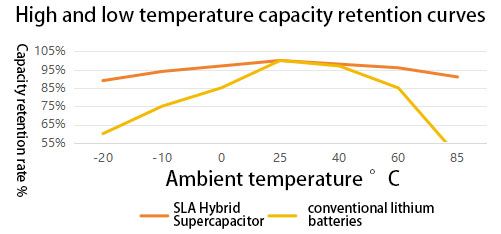
[Figure 1: High and Low Temperature Performance Curves – SLA Series vs. Conventional Lithium Batteries, Capacity Retention Rate Comparison from -20℃ to +85℃]
High Temperature Float Charge Life: At 85℃ and 1000 hours of rated voltage float charging, the SLA series capacity decay is ≤30%.
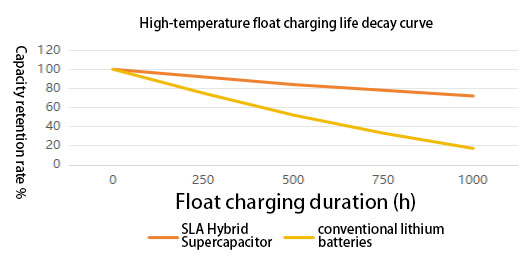
[Figure 2: High-Temperature Float Charge Life Comparison Curve—SLA Series vs. Conventional Lithium Batteries] Self-Discharge Performance: After being placed in a high-temperature and high-humidity environment for 30 days, the SLA series maintains a voltage retention rate of approximately 99%, while conventional lithium batteries only maintain approximately 94%. This characteristic gives the SLA series a significant advantage in long standby applications, making it a reliable choice for backup power, power loss retention, and devices that are left idle for extended periods.
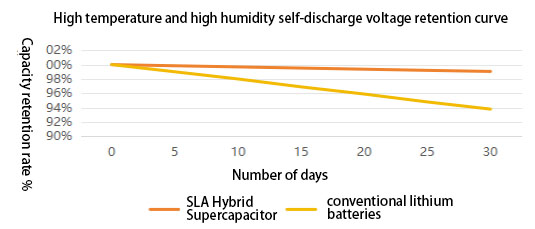
[Figure 3: Self-Discharge Comparison – SLA Series vs. Conventional Lithium Batteries, 30-Day Voltage Retention Rate under High Temperature and Humidity Environment]
Damp Heat Test: 40℃, 95% RH, 1000 hours, no leakage, no bulging, capacity decay ≤30%.
Mechanical Test: After vibration and shock tests, no abnormal electrical performance, no structural damage.
Failure Mode Comparison:
SLA Series: Open circuit failure, no fire, no explosion, no leakage.
Lithium Battery: Thermal runaway, fire, explosion, leakage, release of toxic gases.
Conventional Electrolytic Capacitor: Short circuit, leakage, corrosion of circuit board.
III. Main Models and Technical Parameters
YMIN offers a variety of main SLA series models to meet different application needs:
| Product Image | Product Model | Specifications | Core Features |
| Reference Image (Blue Cylindrical Capacitor) | SLA 3.8V 15F | 6.3×13mm, Operating Temperature: -20℃ ~ 85℃ | Ultra-compact size, ideal for compact PCB design |
| Reference Image (Blue Cylindrical Capacitor) | SLA(H) 3.8V 40F | 8×20mm, Operating Temperature: -40℃ ~ 85℃ | Automotive grade with AEC-Q200 certification, designed for harsh in-vehicle environments |
| Reference Image (Blue Cylindrical Capacitor) | SLA 3.8V 120F | 12.5×20mm, Operating Temperature: -20℃ ~ 85℃ | Low self-discharge (annual self-discharge rate ≤10%), static power consumption 1-2μA |
| Reference Image (Blue Cylindrical Capacitor) | SLA 3.8V 1100F | 18×50mm, Operating Temperature: -20℃ ~ 85℃ | Large-capacity energy storage, meets higher power demand |
IV. Typical Application Scenarios
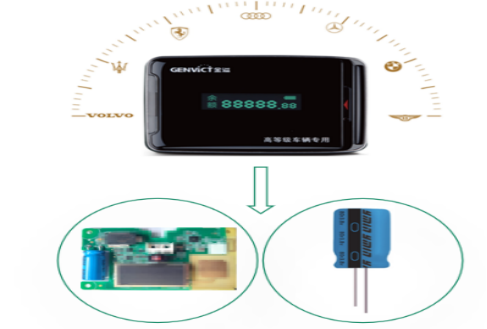
1. Car Dash Cam
Pain Points: Harsh in-vehicle temperatures (-40℃~+85℃), traditional lithium batteries are prone to bulging, leakage, and even fire at high temperatures; rapid video saving is required during power outages, but battery cycle life is short and high-temperature degradation is rapid.
Solution: Using the SLA(H) series as a backup power source during power outages, providing sufficient energy to safely store videos at the moment of power failure.
Advantages: Stable operation at 85℃ for extended periods, no bulging or leakage; over 250,000 cycle life, maintenance-free; already mass-produced and applied to many mainstream car dash cams.
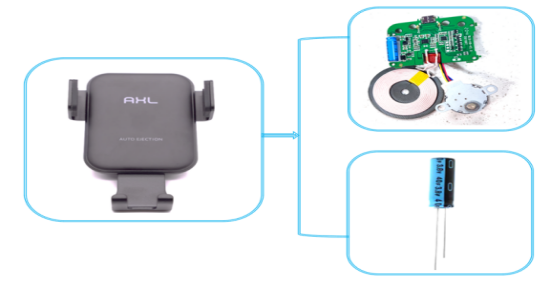
2. Car Wireless Charging Phone Holder
Pain Points: Automatic clamping and power-off memory require short-term backup power; traditional batteries experience a sharp performance drop in high temperatures during summer and pose safety hazards.
Solution: Replace traditional lithium batteries with SLA 15F or 30F batteries.
Advantages: High safety performance, no risk of fire or explosion; can be directly transported by air; minimal performance degradation at high temperatures.
3. Standalone Intelligent Gas Alarm
Pain Points: In gas leak scenarios, any electrical spark could trigger an explosion; traditional batteries pose risks of leakage, short circuits, and fires.
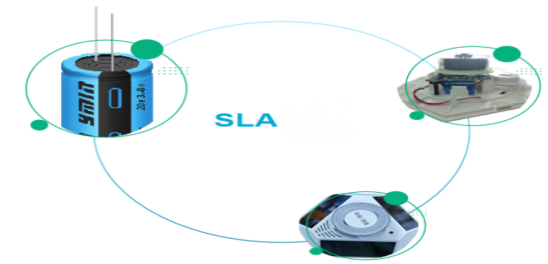
Solution: Replace the 1520 type composite capacitor with an SLA 3.8V 120F capacitor.
Advantages: Fully sealed structure with no leakage; failure mode is open circuit, no electrical sparks generated; low self-discharge and low static power consumption significantly extend standby time; materials are non-toxic and harmless.
V. International Certifications and Technical Support
The YMIN SLA series has obtained multiple international authoritative certifications, providing a solid endorsement for global promotion:
Safety Certifications: UL810A (Component Safety Certification), UN38.3 (Aerospace Transport Safety Certification)
Environmental Certifications: RoHS, REACH
System Certifications: ISO 14001 (Environmental Management System), IATF16949 (Automotive Industry Quality Management System)
Automotive Certification: The SLA(H) series has passed AEC-Q200 automotive-grade certification
Summary
Choosing the YMIN SLA series hybrid supercapacitors means choosing a safer, more compliant, and more environmentally friendly energy storage solution. It not only fundamentally protects your end users from the threat of thermal runaway, but also, in terms of EU regulations, the product is classified as a capacitor, exempt from the new battery regulations (EU 2023/1542), thus avoiding complex processes such as carbon footprint declarations. YMIN provides full technical support from selection and testing to mass application. For complete specifications, please contact the YMIN technical team.

Post time: May-22-2026