Automotive LiDAR
Automotive LiDAR – The “Eyes” of Intelligent Driving
In L3/L4 level intelligent driving systems, automotive LiDAR undertakes core functions such as environmental perception, obstacle recognition, and real-time mapping. Each pulse transmission and echo reception relies on the power supply and signal processing circuitry on the motherboard to provide energy with extremely low ripple and high reliability. However, a common MLCC (Multilayer Ceramic Capacitor) on the board can become the biggest hidden danger affecting radar stability.
01 Wide Temperature + Vibration Environment: MLCC Piezoelectric Effect Causes Radar Failure
Under the combined stress of a wide temperature range (-40℃~125℃) and continuous vibration in an automotive environment, ordinary MLCCs will exhibit a piezoelectric effect—the ceramic dielectric vibrates with voltage changes. After long-term cycling, accumulated deformation leads to micro-cracks inside the capacitor, eventually causing a sudden drop in capacitance, open circuit, or short circuit.
Radar Response Delay: After the filter capacitor fails, the DC-DC output ripple increases dramatically, the power supply to the computing core fluctuates, and point cloud data processing experiences delays of tens of milliseconds, resulting in a lagging vehicle obstacle avoidance response.
Abnormal Noise: The piezoelectric effect itself causes MLCCs to emit high-frequency whistling sounds, interfering with cabin comfort.
Functional Loss: As cracks continue to propagate, the entire LiDAR unit fails, forcing the intelligent driving system to downgrade or shut down.
The root cause is that the piezoelectric effect of MLCCs is an inherent physical property of their ceramic dielectric material and cannot be completely eliminated through process improvements. Even with high-voltage, high-capacitance automotive-grade MLCCs, microcracks and fractures remain probabilistic events under wide-temperature vibration conditions—it’s not a question of “whether it will happen,” but rather “when it will happen.”
02 YMIN Solid-Liquid Hybrid Capacitor Solution: Physically Eliminating the Piezoelectric Effect
From an engineering physics perspective, MLCCs, using ceramic as the dielectric, exhibit an inverse piezoelectric effect under alternating electric fields, causing mechanical deformation of the device. In the high-frequency vibration and high-low temperature cycling environment of LiDAR, continuous deformation gradually causes microcracks inside the device, eventually leading to malfunctions such as decreased capacitance and increased leakage current.
This problem is a structural limitation of ceramic dielectrics and cannot be completely solved by changing brands or optimizing processes. Therefore, selecting alternative components using different technological approaches is the fundamental way to solve this problem.
03 YMIN Solid-Liquid Hybrid Capacitor Overall Solution
Core Technology/Production/Quality Control Advantages
3.1 Core Advantages
YMIN’s VHT series solid-liquid hybrid capacitors use non-piezoelectric dielectrics, exhibiting no deformation or cracking under a wide temperature range (-55℃~125℃) and continuous vibration. They also possess low ESR and high ripple current withstand capability, directly replacing MLCC arrays for filtering and energy storage functions.
3.2 Recommended Specifications
YMIN offers two core specifications for the two key circuit nodes of LiDAR:
· VHT 50V 220μF 10×13
→ Used for LiDAR transmitter power supply + computing core main power supply: Provides a stable, low-impedance power supply, ensuring sufficient transmitted pulse energy and preventing the computing chip from failing due to power supply fluctuations.
• VHT 35V 100μF 6.3×7.7
→ For DC-DC input ripple suppression: Placed close to the computing core, it keeps switching ripple at an extremely low level, reducing ripple voltage and preventing impact on the computing core (such as data errors and timing jitter).
A 50V solid-liquid hybrid capacitor “conserves energy,” while a 35V solid-liquid hybrid capacitor “filters noise,” jointly ensuring the real-time performance and reliability of the LiDAR under wide temperature and vibration conditions.
In addition to the recommended models above, YMIN’s VHT series solid-liquid hybrid capacitors offer more capacitance values and sizes to flexibly adapt to different LiDAR solutions. Further selection consultation is welcome.

3.3 Case Study Analysis
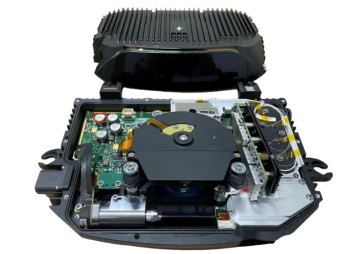
Figure: Schematic diagram of a PCB board for a LiDAR system using YMIN solid-liquid hybrid capacitors instead of ceramic capacitors.
A domestic Tier 1 manufacturer’s LiDAR project originally used a large number of parallel MLCCs in a matrix at the transmitter to meet the instantaneous high current requirements. However, this had the following problems: the PCB area was significantly occupied by the capacitor matrix, and abnormal noises and occasional delays occurred during vehicle vibration testing. The customer replaced the entire MLCC matrix with YMIN VHT series solid-liquid hybrid capacitors. After the replacement: PCB space was significantly freed up, the piezoelectric effect was completely eliminated, the BOM cost was significantly reduced, and the reliance on high-priced, long-lead-time automotive-grade MLCCs was eliminated.
04 Scenario-based Q&A
Q1: We are designing an automotive LiDAR system with limited PCB space. Can the YMIN VHT series directly replace the existing MLCCs? Is any circuit modification required?
A1: Yes, it can be directly replaced. We recommend using VHT 50V 220μF 10*13 capacitors for main power supply and energy storage in the transmitter and computing core, and VHT 35V 100μF 6.3*7.7 capacitors for short-circuit filtering of the DCDC input. Both models are compatible with aluminum electrolytic capacitors of the same specifications, requiring no PCB layout modifications. Our only suggestion: the solid-liquid hybrid capacitor has extremely low ESR and can be directly replaced in the original MLCC location, replacing the MLCC matrix.
Q2: YMIN solid-liquid hybrid capacitors are more expensive than ordinary MLCCs. The boss asked why it’s worthwhile. How is the TCO calculated?
A2: Calculation logic: Using YMIN capacitors for each LiDAR unit costs a single-digit extra compared to using MLCCs. However, the after-sales replacement and calibration costs for a single LiDAR unit due to MLCC breakage can reach thousands to tens of thousands of yuan. Paying a few extra dollars is equivalent to buying out thousands of yuan worth of repair risk, while avoiding a vehicle recall caused by capacitor failure (a single recall costs over a million yuan). The total lifecycle TCO is significantly reduced. Q3: Besides replacing the capacitor, are there any other ways to solve the MLCC squealing and delay? Why is a hybrid solid-liquid capacitor ultimately recommended?
A3: Other methods, such as changing the PCB layout or using series resistors for damping, can only alleviate the squealing, but cannot fundamentally solve the ceramic microcracks caused by the piezoelectric effect—the cracks will still propagate under long-term wide-temperature vibration, eventually leading to an open circuit or short circuit in the capacitor. YMIN hybrid solid-liquid capacitors use non-piezoelectric dielectrics, physically eliminating both abnormal noise and the risk of breakage, without requiring any additional external components, providing a fundamental solution.
From “Performance Standards Met” to “Saving Money and Reducing Risk for Customers”
YMIN’s VHT series hybrid solid-liquid capacitors offer a physically-based alternative to the MLCC failure problem in LiDAR under wide-temperature and vibration conditions, fundamentally eliminating the piezoelectric effect. Compared to MLCCs, it does not rely on “probabilistic failure,” but structurally ensures no deformation, no cracks, no delay, and no abnormal noise. This solution not only reduces the material and after-sales costs per radar unit, but also helps automakers avoid large-scale recall crises and accelerates the deployment of L3/L4 autonomous driving.
Experiencing MLCC whine or piezoelectric effect problems? Contact YMIN immediately to obtain specifications, free samples, test reports, and 3D CAD models—a one-stop solution to your selection dilemmas.
[Abstract]
“Applicable Scenarios”: “LiDAR transmitter power supply, MLCC matrix replacement, transmitter power supply, automotive electronics, autonomous driving, DC-DC converter, computing core power supply”,
“Core Advantages”: “Significantly reduced BOM cost, significantly freed up PCB space, completely eliminated piezoelectric effect-induced noise and microcrack failures, significantly reduced TCO”,
“Recommended Models”: “VHT 50V 220μF 10×13 (transmitter main power supply), VHT 35V 100μF 6.3×7.7 (DC-DC ripple suppression)”,
“Action Guide”: “Request samples and specifications, technical selection consultation, visit the official website www.ymin.com, 3D CAD model”
Post time: Jun-29-2026