In heavy truck transportation scenarios, the losses from a single “failure to start” often far exceed the cost of a battery itself.
It can mean:
* A delayed transport trip
* Highway roadside assistance costs
* A driver being out of work and waiting
* A customer complaint or even a claim
Especially in northern low temperatures, long periods of parking, and frequent start-stop operations, vehicle power systems are facing increasingly greater reliability challenges.
With the increasing use of 4G intelligent connectivity systems, in-vehicle terminals, parking air conditioners, and household electrical equipment, traditional lead-acid batteries must handle both parking power and engine starting. This “dual load” is becoming a core pain point for heavy truck starting systems.
For OEMs and system engineers, the real challenge is not “whether the vehicle can start,” but rather:
How to maintain long-term stable starting capability under extreme conditions.
Why are traditional lead-acid solutions increasingly unable to meet the demands?
In traditional heavy-duty truck power systems, lead-acid batteries have long served two purposes:
1. Providing power during prolonged parking
2. Delivering high current during engine cold starts
This is inherently a contradictory design.
In scenarios with frequent parking and frequent start-stop cycles, the lead-acid system faces significant shortcomings:
① Insufficient cycle life
Lead-acid batteries rely on chemical reactions for energy storage, and under deep charge-discharge conditions, active materials are prone to shedding.
Frequent parking and starting accelerate aging, leading to:
1. Premature battery life degradation
2. Reduced starting capability
3. Increased maintenance frequency
Many problems that arise later in projects are not due to design flaws, but rather because the traditional energy storage system is no longer adequate for the new power consumption scenarios of commercial vehicles.
② Reduced starting capability in extremely cold environments
In low-temperature environments such as -40℃, the internal resistance of lead-acid batteries increases significantly, and their discharge capability decreases rapidly.
Even if the State of Charge (SOC) still has some reserve, it may not be able to release a sufficient large current in a short time, ultimately leading to:
1. Engine failure to start
2. Vehicle stalling in low temperatures
3. Decreased operational reliability in winter
For commercial vehicle customers, the truly expensive component is never the battery itself.
It’s:
Vehicle downtime
Inability to start in winter
Frequent repairs
Repeated debugging later
Long-term maintenance costs
Therefore, more and more OEMs and system customers are beginning to re-evaluate traditional starting architectures.
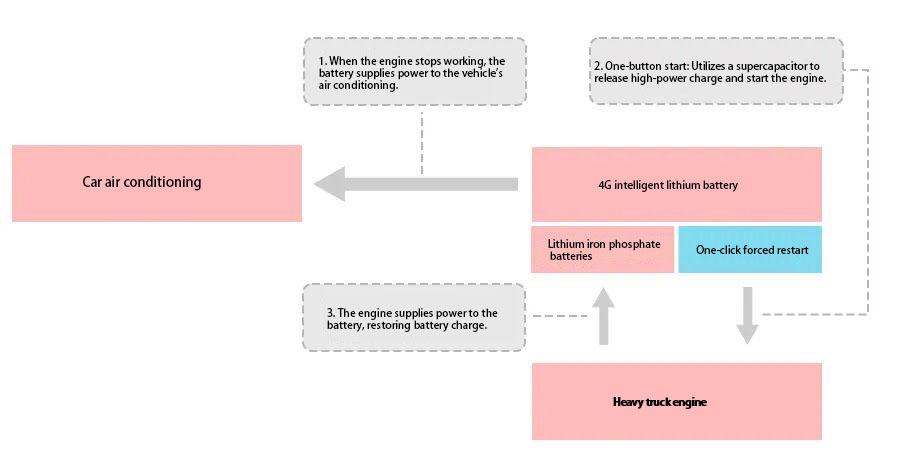
How does YMIN solve the reliability problem of “one-button forced start”?
Addressing the challenges of low-temperature starting and parking-related battery drain in heavy-duty trucks, YMIN proposed:
A collaborative architecture of “power lithium battery + supercapacitor”.
Where:
The lithium battery is responsible for energy storage
The supercapacitor is responsible for instantaneous power output
Through the rational division of “energy” and “power”, the system has both long-term power supply capability and the ability to quickly release the large current required for starting in extreme environments.
Compared to traditional single lead-acid systems, the greatest value of this approach is not merely its ability to “start up.”
It lies in maintaining predictable, quantifiable, and verifiable startup reliability even under complex operating conditions.
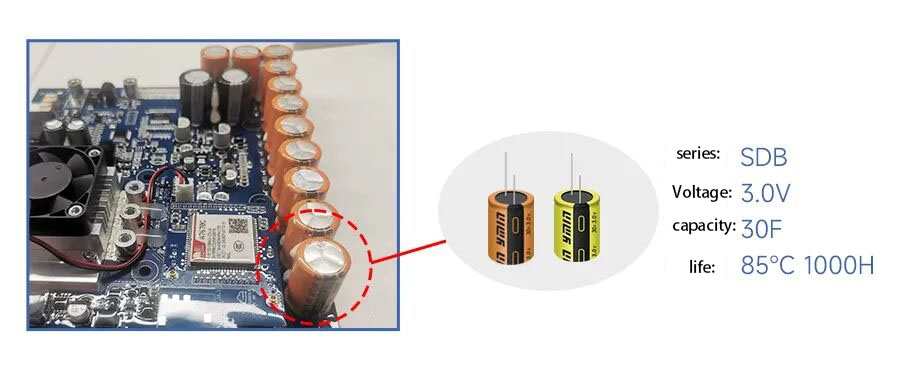
YMIN Supercapacitor SDB Series: More Than Just Parameter Upgrades, It Enhances System Value
For heavy-duty truck 4G intelligent lithium battery one-button start applications, YMIN has launched automotive-grade supercapacitors:
SDB 3.0V 30F 16×25 Series
Their core value lies not only in performance indicators, but also in the long-term operational value for customers.
| Technical Capability | Product Features | Core Value to Customers | Practical Significance to Customers’ Business |
| Ultra-high Power Density | Delivers high-magnitude current output in milliseconds, meeting the high current demand for engine cold start | - Improve the success rate of one-time start- Reduce the risk of start failure in low temperature- Enhance the stability of winter operation | Especially in extremely cold northern regions, it can significantly reduce the probability of vehicle “stranding”, and cut the parking and rescue costs caused by failed starts |
| Long Cycle Life | Single cell cycle life up to 500,000 times; module-level cycle life over 100,000 times | - Reduce the frequency of post-maintenance- Extend the service life of the system- Cut replacement and rework costs | Reduce after-sales pressure, lower the shutdown risk caused by frequent maintenance, and improve the long-term operation stability of the whole vehicle |
| High and Low Temperature Resistance | Maintains low ESR and stable high current output at -40°C; operates stably for 1000 hours at 85°C | - Improve reliability in extreme environments- Enhance system safety redundancy- Boost environmental adaptability | Meet the long-term stable operation requirements of heavy trucks under complex working conditions such as extremely cold, high temperature and frequent start-stop |
| High Voltage + Miniaturization | 3.0V rated voltage reduces the number of series connections; 16×25mm miniaturized size | - Reduce module volume- Improve energy density- Enhance the flexibility of vehicle layout | Assist engineers in lightweight and compact module design, and optimize system space utilization |
| Automotive-grade Reliability | AEC-Q200 certified, and manufactured under the IATF16949 system | - Easier to pass reliability verification- Reduce project introduction risks- Meet the functional safety requirements of the whole vehicle | Shorten the project verification and development cycle, and reduce the brand reputation loss and after-sales risks caused by system failure |
| High Safety Performance | No fire or explosion even if failure occurs under extreme working conditions | - Improve system safety- Reduce the risk of safety accidents | For commercial vehicle customers, this is not only a safety issue, but also directly related to brand reputation and long-term operation stability |
| System-level Value | Supercapacitor + lithium battery collaborative architecture | - Improve system reliability- Reduce TCO (Total Cost of Ownership)- Enhance long-term operation efficiency | Customers purchase not only components, but also a “low-risk, low-maintenance, high-reliability” power supply solution |
Data validation: What customers truly care about is “long-term stability”.
| Verification Item | Test Method / Condition | Test Result | Value to Customers |
| -40℃ Low Temperature Start Test | Continuous test in a -40℃ environmental chamber, multiple triggers of one-key forced start to verify the engine cold start capability | Engine start success rate reaches 100% | - Improve start reliability in extremely cold environments- Reduce the risk of vehicle “stranding” in low temperature- Enhance winter operation stability- Reduce the downtime and rescue costs caused by start failure |
| 100,000 Cycle Life Verification | Adopt the “charge-discharge-standby” cycle mode to conduct 100,000 cycle life test | - Capacity retention rate is still > 80%- Still meets the start requirements | - Extend the service life of the system- Reduce replacement and rework costs- Reduce post-maintenance frequency- Improve long-term operation reliability |
| System Life and Cost Evaluation | With the 10-year vehicle service life as the design goal, evaluate the system integrated with YMIN Supercapacitor SDB series | - System maintenance frequency reduced by 80%- Power system total life cycle cost reduced by approximately 60% | - Significantly reduce after-sales maintenance pressure- Reduce vehicle downtime risk and operation loss- Reduce total cost of ownership (TCO)- Improve customers’ long-term operation revenue |
This means that customers are not just buying a supercapacitor, but a complete power solution with lower risk, lower maintenance, and higher reliability.
Why are more and more customers accepting “more expensive” solutions?
For the commercial vehicle industry, low price never equals low cost.
What truly impacts a customer’s long-term operations are: after-sales frequency, downtime risk, winter failure rate, system stability, and total cost of ownership (TCO).
Compared to “low procurement cost,” more and more customers are focusing on: long-term system reliability, stability under extreme operating conditions, post-project maintenance pressure, and long-term operational benefits.
While YMIN’s SDB series supercapacitors are not the lowest-priced solution, they help customers achieve: lower TCO, higher reliability, and more stable long-term operational capabilities.
YMIN provides more than just products; it provides system-level support.
In addition to automotive-grade supercapacitor products, YMIN can also assist customers with: startup module selection, thermal design optimization, lifespan simulation evaluation,
low-temperature startup verification, and modular circuit design support; helping customers: shorten development cycles, reduce system verification risks, and improve project implementation efficiency.
Conclusion
With the continuous upgrading of heavy-duty truck electrification and intelligence, “being able to start” is no longer the core standard of a starting system.
What truly matters is the ability to maintain stable startup over a long period, even in extreme environments.
This competition is not just about the performance of individual components, but also about the reliability design capabilities of the entire power supply system.
YMIN’s SDB series of supercapacitors aims to help customers solve not only the initial startup problem, but also long-term operational stability, after-sales maintenance pressure, reliability under extreme operating conditions, and total lifecycle cost.
In the future, YMIN will continue to provide more comprehensive solutions for high-reliability power supply systems in commercial vehicles, including selection support, thermal design optimization, lifespan simulation, and system-level solutions, helping customers truly transform “experience redundancy” into “quantifiable reliability design.”
Post time: May-29-2026