As the scale of large-scale model training and inference continues to expand, AI accelerator cards are rapidly entering a new phase of ultra-high power consumption, ultra-high current, and ultra-low voltage.
The new generation of AI GPUs, represented by the NVIDIA H200, has pushed single-card power consumption to the 700W level. The real challenge is shifting from “computing power itself” to system-level power delivery network (PDN) stability. In this context, passive components, especially capacitors, are moving from behind the scenes to the core.
Three Real-World Pain Points Brought by the H200
For hardware engineers, the H200 is not just a more powerful GPU, but a comprehensive test of “extreme operating conditions”:
1. Extreme Transient Load: The switching between idle and full load in AI computing occurs in nanoseconds, with core current instantly jumping to hundreds or even thousands of amperes. Any slow response will cause voltage droop, directly affecting computing stability.
2. High Heat Density and Long-Term Operation: The 700W power consumption is concentrated within an extremely compact package and module space. The GPU operates in a high-temperature environment of 85–105°C for extended periods and requires 24/7 uninterrupted operation, placing extremely high demands on device lifespan.
3. Space Constraints: The GPU and HBM occupy the vast majority of board space, leaving very limited area for power supplies and decoupling devices. High capacitance, small size, and low ESL/ESR become stringent requirements.
YMIN Solutions
In such systems, capacitors are no longer just “filtering devices,” but critical infrastructure for computing power stability:
Transient Energy Support (Decoupling): Capacitors provide critical current compensation in the instant before the VRM responds, preventing voltage collapse.
Ripple Suppression: Power supply noise is controlled within millivolt levels at an ultra-low operating voltage of 0.7–0.8V, ensuring computational accuracy.
System-level reliability assurance: Maintaining long-term stability of the power supply network under high temperature, high load, and long-term operation conditions.
In AI acceleration platforms like the H200, capacitor reliability directly defines the sustainability of computing power. For YMIN, capacitors are not just independent components, but rather an energy system that operates collaboratively throughout the entire power supply path of the AI server.
YMIN AI Server Capacitor Solution Approach
Faced with the challenges of the H200 level, a single type of capacitor is no longer sufficient.
YMIN provides a complete capacitor solution covering “power supply → board level → GPU → system backup”:
Figure 1: Power supply diagram of YMIN AI Server capacitor solution
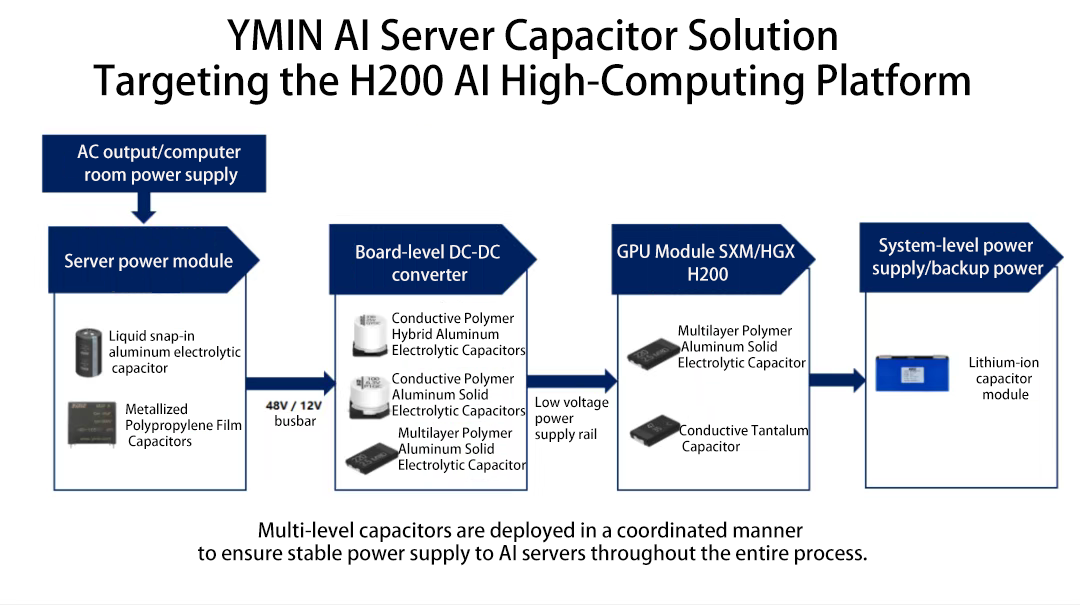
YMIN achieves stable support for extreme transient loads, high heat density, and 24/7 operation by deploying various capacitor technologies in synergy across different voltage levels and frequency bands.
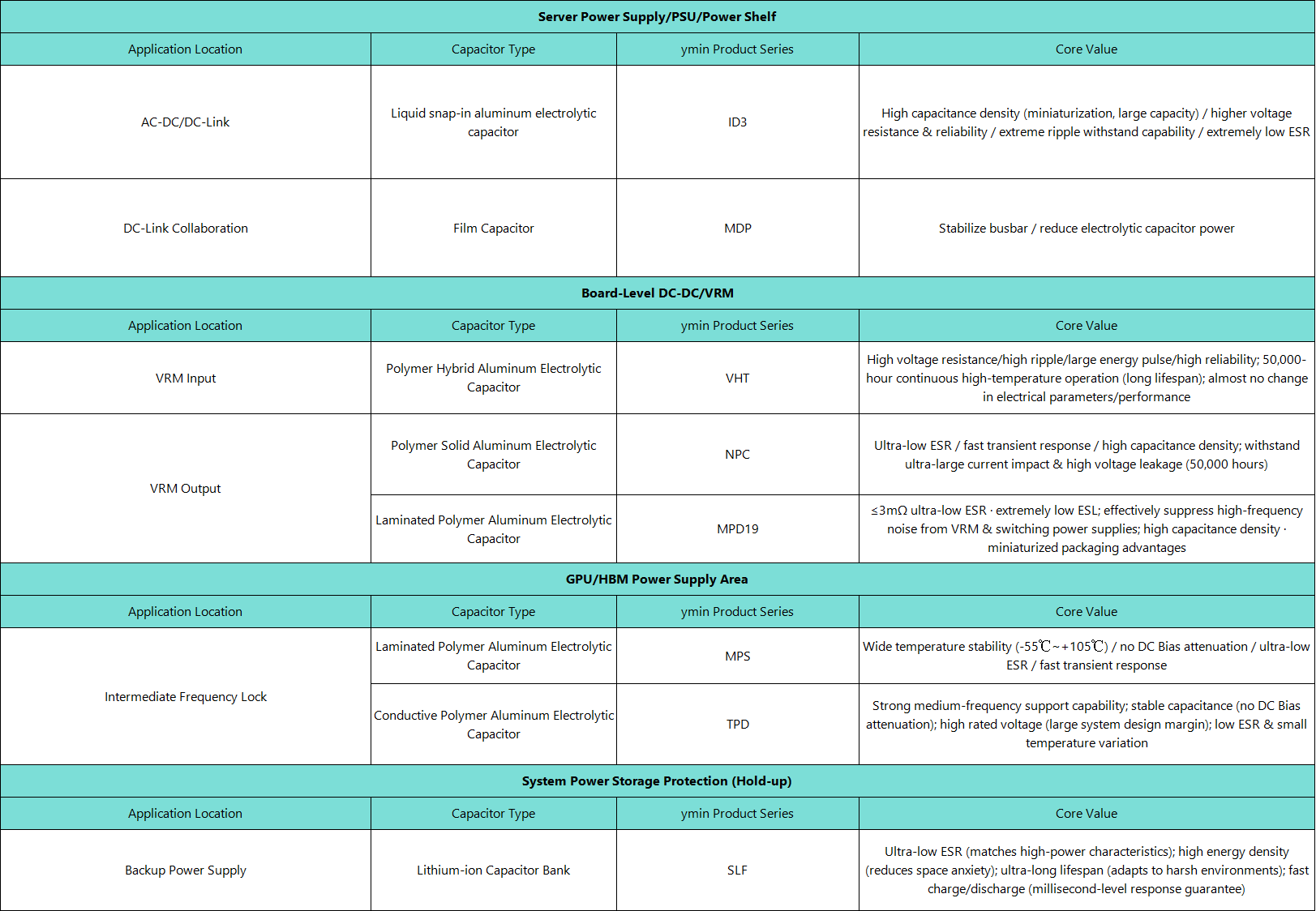
Conclusion: In the era of computing power, stability is equally important.
The competition for AI computing power is no longer just about GPU manufacturing processes and architectures, but also about the reliability of power supply networks. In high-end AI platforms like the H200, the performance and lifespan of a single capacitor can determine the operational stability of the entire server. YMIN focuses on providing reliable and sustainable capacitor solutions for AI servers, ensuring that every watt of computing power is built on a stable power foundation.
Post time: Dec-23-2025