TQD42:
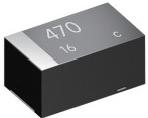
◆Slim profile (L7.3×W4.3×H4.2)
◆Bottom terminals, low ESL
◆High voltage withstand (100V max.)
◆RoHS compliant (2011/65/EU)
◆Slim profile (L7.3×W4.3×H4.2)
◆Bottom terminals, low ESL
◆High voltage withstand (100V max.)
◆RoHS compliant (2011/65/EU)
In AI servers, SSDs are the core component for data storage and retrieval, and their performance directly impacts training and inference efficiency. With the widespread adoption of PCIe 5.0/6.0 interfaces, SSD power consumption and instantaneous current requirements have increased significantly, making the selection of Power Loss Protection (PLP) capacitors crucial for system stability.
Especially under conditions of high temperature, high load, and 24/7 continuous operation, capacitors must simultaneously meet multiple requirements, including low ESR, high capacitance density, long lifespan, and high-temperature stability. Otherwise, data loss, firmware corruption, or system crashes may occur.
Why Capacitor Selection Directly Affects SSD Performance and Lifespan
When an SSD experiences a sudden power outage, the PLP capacitor must release its stored energy within milliseconds to ensure the safe writing of data to the NAND flash memory. If the capacitor's ESR is too high, a large voltage drop will occur during discharge, potentially leading to write failure. If the capacitance is insufficient or the capacitance value decays significantly at high temperatures, it cannot provide sufficient hold-up time. Furthermore, in compact M.2 SSDs (e.g., 5mm thick), capacitor height is often limited to below 1.9mm, and volumetric efficiency (CV value) directly determines whether sufficient energy storage can be achieved within a limited space.
YMIN Capacitor Solutions
Breaking through storage bottlenecks to meet the needs of the AI era
Solution A: Conductive Polymer Tantalum Electrolytic Capacitors – A Benchmark for Ultimate Space Performance
YMIN's TQD series conductive polymer tantalum electrolytic capacitors, with their ultra-thin design (1.5mm), are perfectly suited for ultra-thin M.2 SSDs, solving the space limitation problem. The high CV value (1.0μF/mm³) and high-temperature stability of tantalum capacitors ensure that even in a very small volume, they can provide sufficient power-off protection energy for the SSD, ensuring its stable operation for a long time under high temperature and high load environments.
Ultra-thin and High-Density: The TQD series can be as low as 1.5mm in height and has a CV value as high as 1.0μF/mm³, making it an ideal choice for ultra-thin M.2 SSDs.
Robust and Durable: A novel all-solid-state, full-size structure with a lifespan exceeding 100,000 hours at 75°C, and passing rigorous double 85°C testing, maintaining stability under long-term high temperature and humidity conditions.
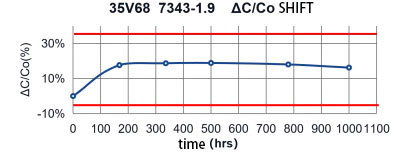
Stable Performance: Chart data shows minimal changes in capacitance (C) and equivalent series resistance (ESR) with time and temperature, providing continuous and reliable protection.
Long Lifespan and High Weather Resistance: An all-solid-state structure with an expected lifespan exceeding 100,000 hours at 75°C. Multiple moisture-proof measures ensure the product passes double 85°C constant temperature and humidity testing, suitable for stable operation under long-term high-temperature loads.
Figure 1: LC Change of a 35V 68μF Tantalum Capacitor over Time
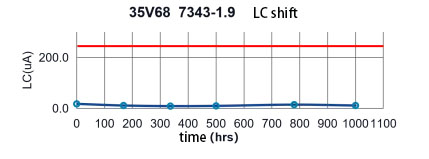
Figure 2: ESR variation of a 35V 68μF tantalum capacitor over time
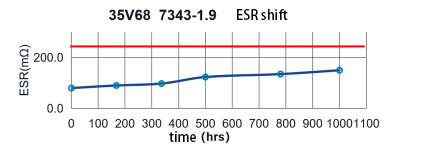
Figure 3: Change of ΔC/Co over time for a 35V 68μF tantalum capacitor
Option B: Polymer Hybrid Aluminum Electrolytic Capacitors – A Top Choice for High Reliability and Cost-Effectiveness
For enterprise-grade SSDs requiring large capacities, ymin's polymer hybrid aluminum electrolytic capacitors are an ideal choice due to their superior cost-effectiveness. They offer an exceptionally long lifespan of 10,000 hours at 105℃, maintaining low ESR and good capacity stability even in environments with significant temperature variations.
Long-lasting and durable: Providing over 10,000 hours of operation at 105℃, meeting the long-term operational needs of servers.
System-friendly: The failure mode is "open circuit," offering greater security redundancy for high-value data storage systems compared to short-circuit mode.
Cost advantage: Significantly optimizing BOM costs while achieving similar performance, making it an excellent choice for mainstream and large-capacity enterprise-grade SSDs.
ymin Conductive Polymer Tantalum vs. Solid-Liquid Hybrid Aluminum Electrolytic Capacitors
To address the above challenges, ymin offers two mainstream PLP capacitor solutions. The following is a structured comparison based on measured data:
Table 1: Conductive Polymer Tantalum & Solid-Liquid Hybrid Aluminum Electrolytic Capacitor Product Characteristics
| Characteristic Dimension | Conductive Polymer Tantalum Electrolytic Capacitor | Polymer Hybrid Power Aluminum Electrolytic Capacitor | SSD Design Value |
| Volume Efficiency (CV Value) | Extremely High (1.0μF/mm³) | High (0.46μF/mm³) | Tantalum capacitors are the first choice for ultra-compact design |
| Product Height | Ultra-thin, can be as low as 1.5mm | Small diameter, surface-mounted with a height of about 3.55mm | Tantalum capacitors do not require PCB slotting; aluminum electrolytic capacitors require PCB slotting design |
| Equivalent Series Resistance (ESR) | Low | Extremely Low | Hybrid aluminum electrolytic capacitors have better instantaneous discharge capacity and response |
| Service Life | Extremely Long (All-solid-state) | Long (Liquid-solid Hybrid System) | Both meet long service life requirements, and the theoretical service life of tantalum capacitors is better |
| Temperature Characteristics | Excellent, capacitance value/ESR change little with temperature | Good, capacitance value/ESR change little with temperature | Both perform stably in high-temperature environments |
| Failure Mode | Short-circuit (Circuit protection design required) | Open-circuit | The failure mode of hybrid aluminum electrolytic capacitors is safer, with lower system risk |
| Cost | Higher | Has significant advantages | Hybrid aluminum electrolytic capacitors can greatly optimize the overall cost |
Table 2: Comparison of Typical Specifications for Conductive Polymer Tantalum & Solid-Liquid Hybrid Aluminum Electrolytic Cells
| Key Parameter / Capability Value | YMIN Aluminum Electrolytic Capacitor TQD 35V47μF (7.3 * 4.3 * 1.5) | Solid Hybrid Aluminum Electrolytic Capacitor NGY 35V100μF (5 * 11) |
| Surge Voltage | 41V | 41V |
| Peak Withstand Voltage (Transient) | 47.3V | 55V |
| Supportable Working Voltage | 35V | 35V |
| Capacitance Tolerance Range | ±20% | ±10% |
| Typical Capacitance Value | Around 42μF | Around 105μF |
| Specific Dimensions | 7.3x4.3x1.5mm, Capacitor Height: 1.5mm | φ5.0x11.5mm, Capacitor Laying - down Height: 5.0mm (Supports laying - down mounting, PCB slot design required) |
| Operating Temperature Range | -55℃~ +105℃ | -55℃~ +105℃ |
| Expected Lifetime | >2000 hours @ 105℃ | >10000 hours @ 105℃ |
| >100000 hours @ 75℃ | >80000 hours @ 75℃ | |
| Capacitance Lower Limit at the End of Rated Lifetime | Above 90% of the initial capacitance value | Above 85% of the initial capacitance value |
| Capacitance Variation with Temperature | -5%~ +20% range (-55℃~ +105℃) | ±7% range (-55℃~ +105℃) |
| Charge - Discharge Withstand Capability | After 20,000 charge - discharge cycles, the capacitance remains above 90% of the initial value | After 20,000 charge - discharge cycles, the capacitance remains above 90% of the initial value |
| Cost Comparison | 100% (Benchmark) | Around 15% (Material cost + system cost, expected total reduction of about 85%) |
Comparison of YMIN Capacitor Solutions: Perfectly Adaptable to Different SSD Application Needs
Table 3: YMIN Capacitor Selection Recommendations for Different SSDs
| SSD Application Scenarios | Recommended Solution | Core Reason | YMIN Typical Specification Reference |
| Ultra - thin M.2 SSD (5mm thick) | Conductive Polymer Tantalum Electrolytic Capacitor | The only solution that can provide high capacitance at the millimeter - level height | TQD 35V 47μF (1.5mm high) |
| High - performance AI Server SSD | Conductive Polymer Tantalum Electrolytic Capacitor | Long lifespan, high reliability, matching the server warranty period | TQD 35V 47/68μF |
| Mainstream/Cost - sensitive SATA SSD | Polymer Hybrid Power Aluminum Electrolytic Capacitor | Best cost - performance ratio, ensuring basic reliability and lifespan | NGY 35V 100μF |
| Large - capacity Enterprise - level U.2 SSD | Dual solutions available | Top - notch performance: High cost - performance of tantalum capacitors; Hybrid aluminum capacitors | Customized according to customer cost and performance goals |
Q&A Section
Q: How to choose between the two types of capacitors?
A: The choice depends on your core requirements.
If your design faces extreme space constraints (such as ultra-thin M.2) and requires top-tier high-temperature stability and long lifespan, ymin conductive polymer tantalum electrolytic capacitors are your ideal choice.
If your design has some layout space and seeks the best balance between reliability and total system cost, while favoring a safer "open-circuit" failure mode, Ymin polymer hybrid aluminum electrolytic capacitors are a better solution.
Conclusion
Choose ymin to ensure the stability and performance of your AI server storage system.
ymin offers two core product lines in the capacitor field—conductive polymer tantalum electrolytic capacitors and polymer hybrid aluminum electrolytic capacitors. Whether for space-constrained ultra-thin SSDs or enterprise-grade SSDs requiring high capacity and high power support, we can provide professional and reliable capacitor selection advice, helping customers find the best balance between performance, cost, and reliability. For detailed specifications, test reports, selection tables, or to request samples, please visit the ymin website or contact our technical support. We can provide one-on-one selection support for your specific project.