During a high-temperature, full-load durability test of the EPS system in a new model from a certain OEM, the controller occasionally triggered a low-voltage alarm under heavy load conditions such as stationary turning and low-speed crossing of speed bumps. This was accompanied by an instantaneous loss of power assist and the instrument panel malfunction indicator light illuminating. Further investigation revealed that the problem was related to the performance degradation of the DC-Link bus capacitor under high temperature and high ripple current conditions, ultimately affecting the vehicle’s reliability testing schedule and posing risks to mass production.
In automotive EPS (Electric Power Steering) controllers, the liquid aluminum electrolytic capacitors at the VBAT input or DC-Link location play a crucial role in stabilizing the bus voltage and absorbing pulses. They are not simply “energy storage components,” but core components affecting system reliability and mass production.
So, given the parallel advancements in high-temperature, heavy-load operation and domestic substitution, what kind of liquid aluminum electrolytic capacitor solution is used in EPS power steering controllers? This is the core question this article will discuss.
I. Core Requirements for Capacitors in EPS Controllers
During low-speed parking, stationary turning, continuous steering correction, and low-speed crossing of speed bumps, the motor-side current pulsation of EPS becomes more pronounced. The VBAT input and DC-Link terminals need to withstand stronger transient impacts. In these situations, if the capacitor’s ESR is too high or its ripple current handling capability is insufficient, problems such as increased bus ripple, aggravated transient voltage drop, and decreased control stability can easily occur.
The challenge in these applications lies not only in “whether it can withstand instantaneous loads,” but also in “whether it can maintain long-term stability at high temperatures.” The root cause of the customer failure case mentioned at the beginning was not just conventional lifespan degradation, but rather the rapid deterioration of the dielectric oxide film and electrolyte system at high temperatures, leading to a significant increase in leakage current in a short period, further causing difficulty in voltage boosting, and ultimately inducing undervoltage alarms and functional abnormalities.
Therefore, capacitor selection should not only consider capacitance value and withstand voltage, but also ESR, ripple current capability, high-temperature lifespan, and project feasibility.
II. What parameters should be considered for capacitors in EPS systems?
For liquid aluminum electrolytic capacitors in automotive EPS power steering controllers, the following indicators are recommended for priority consideration:
1. Voltage rating and capacitance: Do they match the design requirements of the VBAT input or DC-Link bus position?
2. ESR (Equivalent Series Resistance): Does it help reduce ripple and transient voltage drop?
3. Ripple current capability: Can it withstand pulse currents under conditions such as stationary steering and rapid return to center?
4. High-temperature life: Can it withstand long-term high-temperature (135℃) operation?
5. Size and installation method: Is it suitable for existing board space and replacement implementation schedule?
It is important to note that if the project currently focuses on general filtering scenarios with low stress, low temperature, and low ripple, the selection logic is not entirely the same as for high-temperature, heavy-duty controllers like EPS. EPS is not a typical low-stress board-level filtering scenario, therefore, the general approach for liquid aluminum electrolytic capacitors cannot be simply applied.
III. YMIN LKL(R) series: Why is it closer to EPS application requirements?
To address the aforementioned issues, YMIN recommends the LKL(R) series liquid aluminum electrolytic capacitor solution. This series has a very clear role in EPS: it is primarily used at the VBAT input and DC-Link/bulk positions in the main power path of the EPS controller power board for input buffering, absorbing pulse current, suppressing bus ripple and transient voltage drop, and stabilizing the power supply environment.
It is more suitable for EPS not only because of its “superior” parameters, but also because its design logic is closer to the root causes of failure in this type of application: YMIN uses anhydrous high-conductivity electrolyte, high-voltage high-density positive electrode foil, low-density protective paper, and higher-specification process control. Therefore, while suppressing leakage current growth, it also achieves lower ESR performance, which is more conducive to maintaining bus stability under high-temperature and heavy-load conditions, reducing the risk of temperature rise, and improving the long-term reliability of the controller.
IV. From a project implementation perspective, why is domestic substitution not just parameter replacement?
[Recommended Selection] YMIN LKL(R) series has been successfully implemented as a replacement for NCC GPD series in this type of EPS project. After customer replacement and testing, it has passed and is now in mass production. This means that its value is not limited to “comparable parameters”, but rather has the ability to switch from verification to mass production in real projects.
| Recommended Series | Rated voltage (V) | Capacity (μF) | Dimensions D*L (mm) |
| LKL(R) | 25 | 4700 | 16*25 |
| 50 | 3600 | 18*40 | |
| 63 | 2700 | 18*40 |
[Experimental Data Verification]
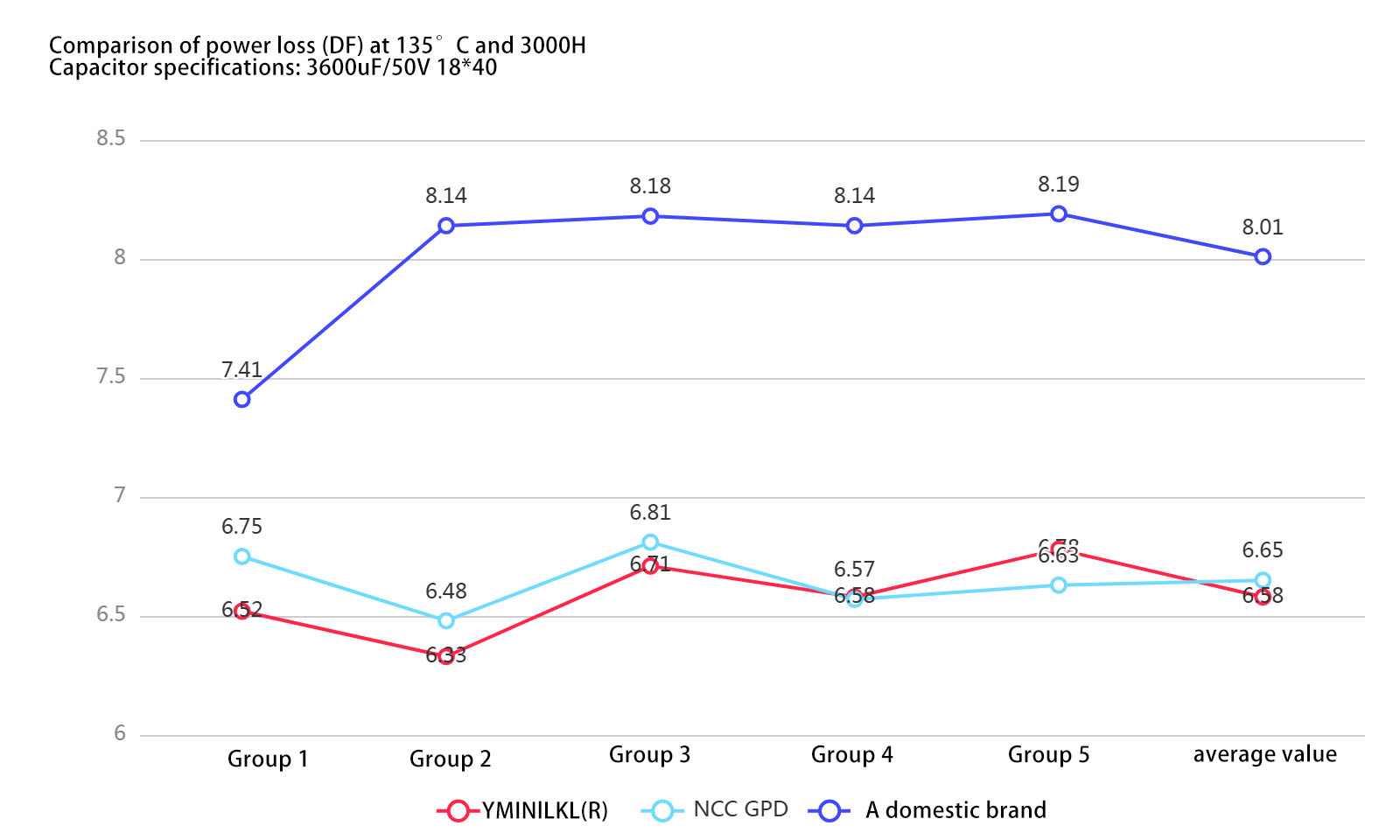
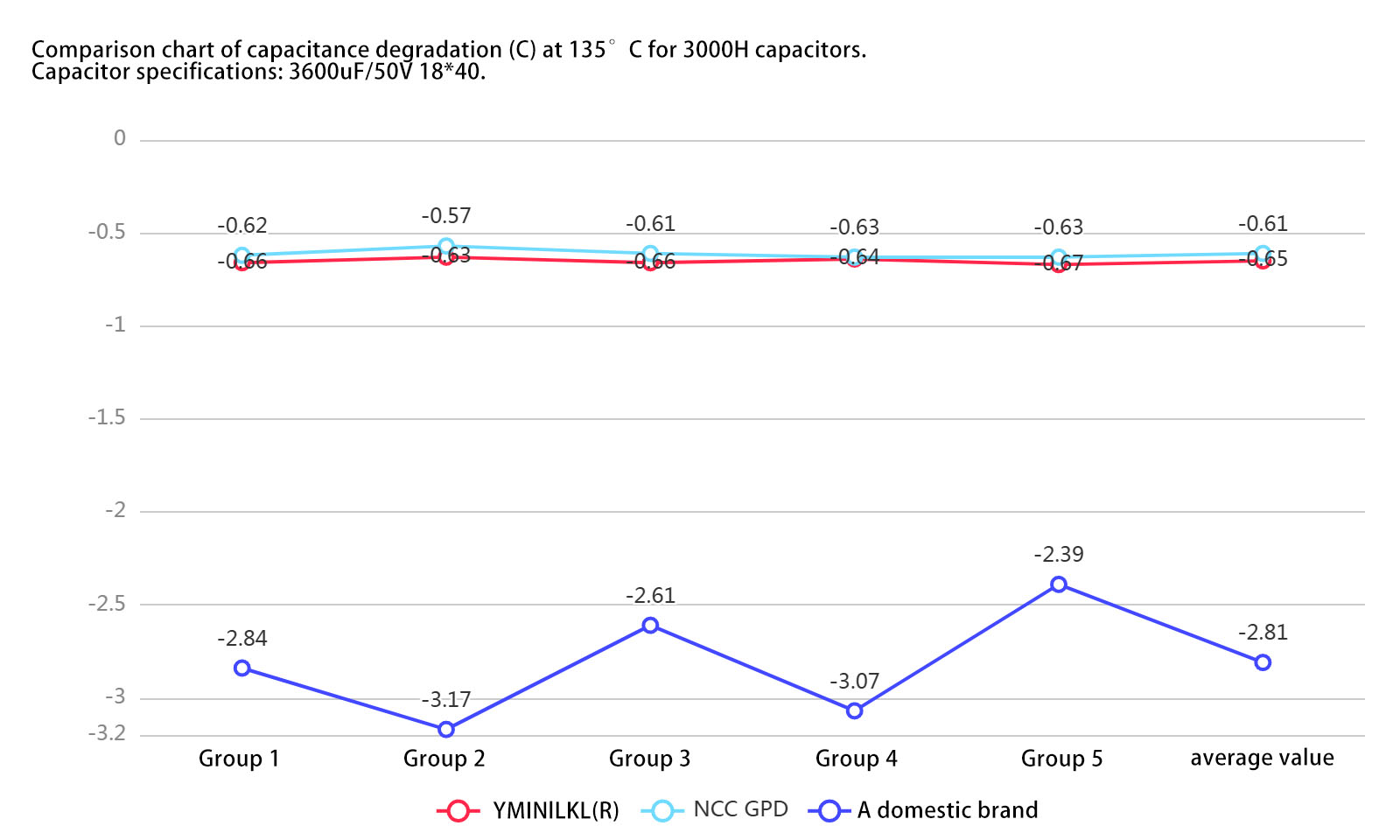
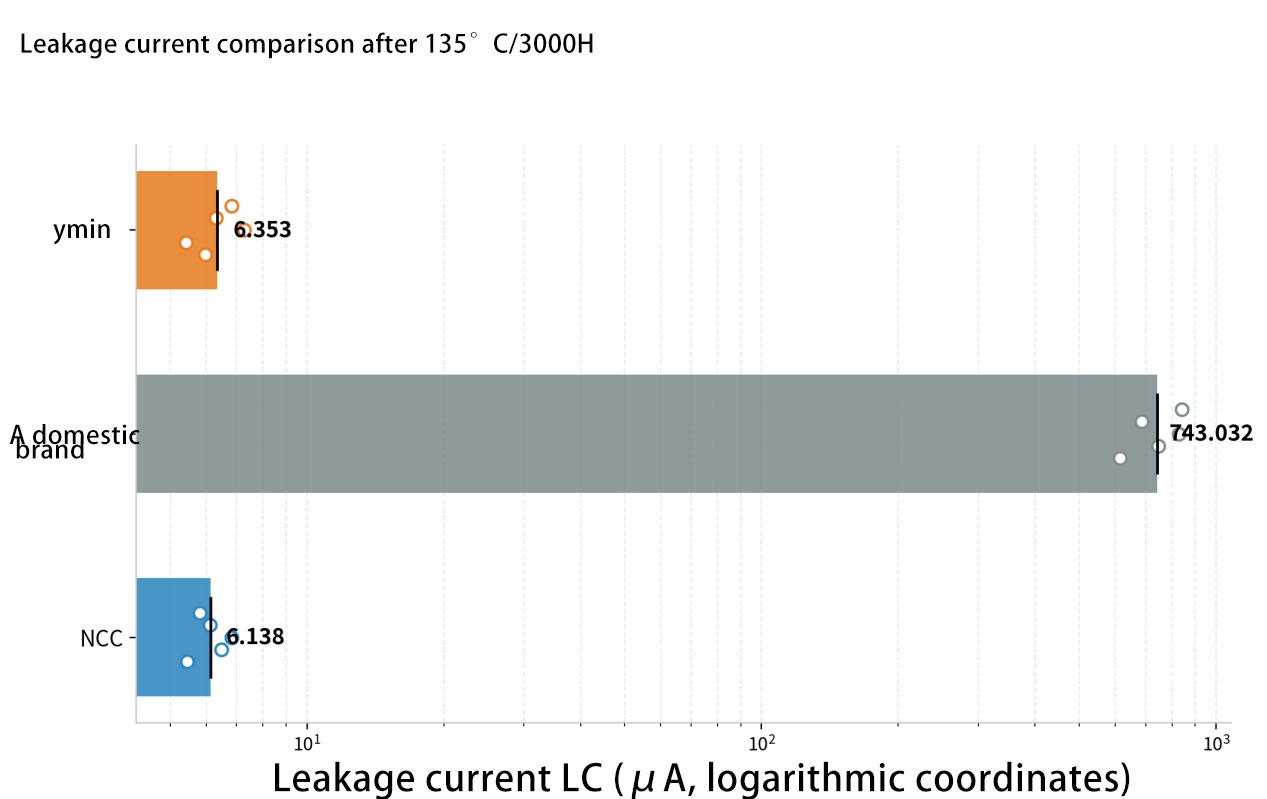
We used 135℃ as the uniform test temperature to test the loss value, capacitance decay change, and leakage current of capacitors from three manufacturers.
Figure 1 shows the average loss values: YMIN 6.584, NCC 6.647, and a certain domestic brand 8.012. A lower loss tangent (DF) value means less heat generation under AC ripple, which helps reduce the temperature rise of the EPS controller, thereby extending the controller’s lifespan.
Figure 1: DF Comparison at 135℃ for 3000 hours
(Comparison of YMIN LKL(R) series, NCC GPD series, and a certain domestic brand series)
A smaller capacitance change rate means a stronger capacitance retention capability under high-temperature conditions, better maintaining the stability of the circuit design and avoiding circuit performance drift caused by capacitance decay. Figure 2 shows the measured capacitance decay data: the capacitance change of YMIN LKL(R) and NCC GPD is controlled within -1%, with similar overall performance; the capacitance decay of another manufacturer’s capacitor reaches -2.814%.
Figure 2: Comparison of Capacitance Decrease (C) under 135℃ 3000H Conditions
(Comparison of YMIN LKL(R) series, NCC GPD series, and a domestic brand series)
Leakage current is a crucial indicator of capacitor performance. In the long-term high-temperature operation of EPS controllers, lower leakage current helps reduce system static power consumption and lowers the risk of circuit failure due to deterioration in insulation performance. Test data shows that the leakage current (LC) values of YMIN LKL(R) and NCC GPD remain at a low level of approximately 6μA, while the leakage current of a certain domestic brand has risen to 743.032μA.
Figure 3: Comparison of Leakage Current (LC) under 135℃ 3000H Conditions
(Comparison of YMIN LKL(R) series, NCC GPD series, and a certain domestic brand series)
VI. Customer FAQs
1. In our EPS project, capacitors are often a weak point during high-temperature aging tests. Are there any recommended alternatives to NCC automotive-grade aluminum electrolytic capacitors with a temperature resistance of over 135℃ and a longer lifespan?
YMIN LKL(R) series liquid aluminum electrolytic capacitors are a recommended solution for these high-temperature, high-ripple, and high-reliability scenarios. Addressing the control voltage fluctuations and functional failures caused by performance degradation of the DC-link bus capacitors in EPS systems under high-temperature and high-ripple current conditions, we have optimized them using 135℃ long-life, low-ESR, high-ripple liquid aluminum electrolytic capacitors, and have formed a domestic alternative to the NCC GPD series.
2. “To suppress high-frequency noise from the EPS motor drive, is a lower ESR for the DC-link capacitor always better? How should we select a low-ESR capacitor based on the switching frequency?”
A: For high-ripple, high-pulsation operating conditions like EPS, a lower ESR is generally more beneficial for reducing voltage drop, improving ripple, and controlling heat generation. However, in engineering practice, one cannot only look at the ESR indicator; it is also necessary to consider ripple current capability, capacitance, withstand voltage, temperature rise, and the actual installation space for a comprehensive judgment.
3. Q: We currently use Japanese GPD/UPW/UPY capacitors in our EPS design. Are there any domestic models that can directly replace them with comparable or even better performance? A: YMIN LKL(R) series capacitors have been successfully implemented as a replacement for the NCC GPD series and have passed customer testing and entered mass production. For specific projects, it is still recommended to select and confirm the appropriate capacitor based on target voltage withstand, capacitance, size, ripple, and lifespan requirements.
VII. Conclusion
In automotive EPS power steering controllers, the value of liquid aluminum electrolytic capacitors lies not only in energy storage but also in their ability to support the stability of the DC-Link bus, control continuity, long-term reliability, and domestic substitution under high-temperature and heavy-load conditions. YMIN LKL(R) series liquid aluminum electrolytic capacitors are designed based on this demand path, providing a solution closer to the application scenario for automotive EPS projects.
For further evaluation of specific models, please contact us to obtain specifications, selection tables, sample support, or test data, and make targeted confirmations based on the project’s voltage withstand, capacitance, size, and lifespan limits.
[Abstract] Applicable Scenarios | VBAT input terminal of automotive EPS power steering controller, DC-Link / Bulk Position
Core Advantages|Low ESR, High Ripple, Long Lifespan at 135℃, Domestic Substitution Introduction
Recommended Model|YMIN LKL(R) 25V 4700μF, 50V 3600μF, 63V 2700μF
Post time: Mar-28-2026