Introduction: Starting with a Specific Engineering Challenge
When your airbag ECU (Electronic Control Unit) project is stalled due to long lead times and cost pressures of NCC capacitors, while simultaneously facing a domestic production deadline, how do you evaluate a capacitor that claims to achieve domestic substitution? This article will take the YMIN LK series as an example, providing an in-depth technical analysis and systematically answering two key questions:
Are the product parameters sufficient to support substitution? (Focusing on benchmarking and surpassing core indicators such as -40℃ ESR (Equivalent Series Resistance) and 105℃ lifespan); Can the commercial value solve the project’s pain points? (Focusing on comprehensive value such as cost, lead time, and supply chain security)
Focusing on Technical Pain Points:
Extreme Requirements of Airbag ECUs for Energy Storage Capacitors
1. Low Temperature Challenge (-40℃)
The instantaneous discharge current and voltage maintenance time requirements of airbag ECUs in extremely low temperature environments are extremely stringent. At low temperatures, the ESR (Equivalent Series Resistance) of capacitors increases dramatically, affecting energy conversion efficiency. Increased ESR directly leads to higher voltage drops, impacting system stability and safety.
2. High Temperature and Lifespan Challenges (105℃)
Electrolyte drying and capacity decay are directly related to capacitor failure. At the extreme temperature of 105℃, capacitor lifespan becomes a critical indicator for the project. Lifespan is not just a number, but the ultimate test of the stability of the material system and process.
3. Cyclic Stress
Facing the durability requirement of 100,000 charge-discharge cycles, the durability of the electrode foil and electrolyte needs rigorous testing to ensure stable performance during frequent self-tests.
Solution Breakdown: The “Technical Formula” of YMIN LK Series
1. Benchmarking Design Philosophy From the outset, YMIN LK series capacitors have been benchmarked against the NCC LBG/LBV series, striving for replacement while maintaining electrical performance compatibility.
2. Automotive-Grade Certification Cornerstone
The LK series has passed AEC-Q200 (Automotive-Grade Passive Device Reliability Standard) certification, meeting the high reliability requirements of the automotive OEM market, especially airbag systems. (Source: Automotive-Grade Certification Certificate)
3. In-Depth Analysis of Core Materials and Processes
High-Conductivity Anhydrous Electrolyte: Reduces low-temperature ESR (Equivalent Series Resistance), improves high-temperature stability, and extends capacitor life.
High-Density Positive Electrode Foil: Enhances the capacitor’s capacity per unit volume and charge retention capability, ensuring the feasibility of miniaturized designs.
Small-Volume, High-Density Process: Improves reliability through optimized structural design, meeting the needs of compact ECU layouts.
Recommended Specifications
| Model | Rated Voltage (V) | Capacitance (μF) | Dimensions D*L (mm) |
| LK | 25V | 4400 μF | 16*20 |
| LK | 25V | 5700 μF | 18*20 |
| LK | 35V | 3000 μF | 16*20 |
| LK | 35V | 4000 μF | 18*20 |
| LK | 35V | 5600 μF | 18*25 |
| LK | 35V | 5600 μF | 18*31.5 |
| LK | 35V | 8800 μF | 18*35.5 |
| LK | 35V | 10000 μF | 18*40 |
Empirical Evidence: A Head-to-Head Competition in the Lab
Evidence 1: Comparative Analysis of ESR (Equivalent Series Resistance) at -40℃
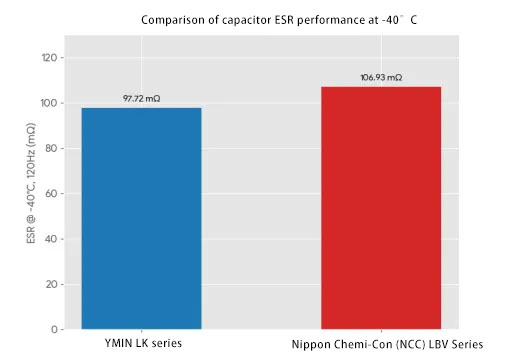
Comparison data of YMIN LK capacitors (ESR value 97.72mΩ) and NCC brand LBV capacitors (ESR value 106.93mΩ) at -40℃/120Hz shows that the LK series exhibits a significant advantage. (Data source: Laboratory measured data)
The calculated difference is approximately 9.2mΩ, which is crucial for the system’s low-temperature discharge current, significantly improving energy conversion efficiency and safety margin.
Figure 1: Comparison of ESR performance between YMIN and NCC capacitors at -40℃
Empirical Evidence 2: Lifetime and Capacitance Decay Tracking at 105℃
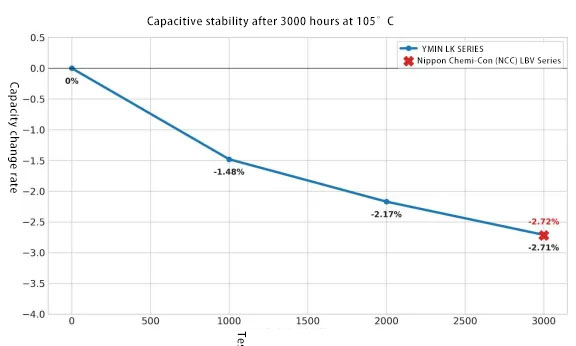
The capacitance decay data of YMIN LK (-2.71%) and NCC LBV (-2.72%) after 3000 hours (source: typical value) are very similar, indicating that the YMIN LK series possesses long-term stability comparable to industry benchmarks.
Figure 2: Comparison of Capacitor Stability after 3000 hours at 105℃
From Lab to Production Line
Engineering and Commercial Considerations for Alternative Implementation
1. Design Checklist
Electrical Compatibility Confirmation: Focus on verifying operating voltage, ripple current, etc., to ensure the alternative solution functions correctly in the system.
Layout and Soldering Compatibility: Minor dimensional differences may cause stress on the PCB, requiring detailed verification.
2. Supply Chain and Commercial Value Reassessment
Quantifying Delivery Time Value: The difference between “long delivery time” and “fast delivery” significantly shortens the project cycle and reduces pressure to meet deadlines.
Cost-Benefit Analysis Framework: From BOM cost and inventory cost to a comprehensive assessment of supply disruption risks, the Yung-Ming LK series demonstrates significant advantages across all indicators.
Conclusion & Frequently Asked Customer Questions
Leveraging technological innovation and material advantages, the Yung-Ming LK series achieves benchmarking and surpassing in capacitor performance. Whether in terms of commercial value, delivery time assurance, or technical reliability, the LK series provides strong support for projects and achieves the goal of domestic substitution.
Q1: Does the Yung-Ming LK series truly replace the NCC LBV/LBG solution in terms of performance?
A1: Provided the target specifications are consistent and board-level verification is completed, it can be considered a domestic alternative. YMIN’s LK series is designed to directly compete with benchmarks. Data shows that its -40℃ low-temperature ESR (equivalent series resistance) (97.72mΩ) is superior to benchmark products, and its 105℃ high-temperature lifespan and capacitance decay rate (-2.71%) are on par with the benchmark. Furthermore, the entire series has passed AEC-Q200 (automotive-grade passive device reliability standard) certification, meeting the highest automotive-grade reliability requirements and possessing drop-in replacement potential. Further confirmation through actual testing is recommended.
Q2: Besides performance, what additional value does switching to YMIN’s solution bring?
A2: Switching to YMIN’s capacitor solution is equivalent to obtaining “technical insurance” while unlocking three major strategic benefits:
1. Significantly enhanced supply chain resilience: Procurement lead times are significantly shortened, improving supply chain responsiveness and resilience.
2. Enhanced Cost Competitiveness: While maintaining the same quality, directly optimize BOM costs, unlocking greater profit margins and market pricing power for your products.
3. Strategic Compliance: Meet the requirements for the localization rate of core components, enhancing the self-control and autonomy of the supply chain.
Action Guidance
Get Complete Data: Click the link to download more detailed test reports and specifications.
Technical Support: Engineers with alternative needs can contact our technical support team for one-on-one solution discussions.
[Abstract]
Applicable Scenarios | New Energy Vehicle Airbag ECU (Electronic Control Unit)
Core Advantages | Superior ESR performance at -40℃, stable at 105℃, shorter delivery time, supports domestic substitution
Recommended Models | LK 25V 4400μF / 25V 5700μF / 35V 3000μF / 35V 4000μF / 35V 5600μF / 35V 8800μF / 35V 10000μF
Post time: Mar-18-2026