In enterprise-level servers, disk arrays, and edge storage devices, RAID arrays typically store data being written and critical metadata in a cache (high-speed cache memory) to improve write performance. When the entire system experiences a sudden power loss, if the backup power source cannot take over in time, data in the cache that has not yet been written to disk may not have time to be written back to the Flash memory or backend disks, leading to risks to data consistency and business continuity.
While traditional backup battery units (BBUs) can be used for backup power, in long-term 24/7 operation scenarios, they often suffer from drawbacks such as capacity decay, self-discharge, periodic calibration, replacement and maintenance, as well as issues related to internal space and heat dissipation pressure in high-density servers. Based on this application requirement, YMIN recommends using the SDM series of RAID write cache protection supercapacitor modules to provide short-term backup power to the RAID controller, ensuring the cache→Flash write process is completed.
Application Scenarios and Typical Challenges
RAID write cache protection is commonly used in server storage, data centers, enterprise-level storage, disk arrays, industrial servers, and edge storage scenarios. Typical triggering conditions include power outages, power module failures, hot-swapping accidents, and PDU malfunctions, all of which can lead to RAID main power interruptions.
Once the main power supply is interrupted, common risks mainly focus on three aspects:
· Dirty data and critical metadata in the write cache cannot be written to Flash or backend disks in time.
· Abnormal power loss of the controller increases array recovery time and raises the risk of service interruption.
· Traditional BBUs, after capacity decay, may not be able to stably cover the entire write-back window, increasing the burden of subsequent maintenance and downtime management.
For high-density 1U/2U servers, these problems are further compounded by space constraints, cabling limitations, and increased heat dissipation pressure, making the installation and maintenance of backup power solutions even more complex.
Root Cause:
RAID write cache protection is not about “long-term battery life”.
The core of RAID write cache protection is not about ensuring the backup power supply continues operating for an extended period after a power outage. Instead, it requires the backup unit to immediately take over after the input power is lost, maintaining a sufficient short-term energy window above the controller’s minimum operating voltage to allow data and critical metadata in the cache to be written back.
The success of this type of protection depends on the matching relationship between several key factors:
· Available energy: E = 1/2 × C × (Vstart² – Vend²)
· Module output current capability
· Connection path loss
· Controller write-back time
When the backup unit responds slowly, has insufficient effective capacity or operating voltage, insufficient maximum discharge current, or excessive wiring and connection losses, the controller voltage may drop too quickly, causing Flash write interruption. In other words, this type of solution is not designed for long-term battery life scenarios, but rather for “short-term takeover during power loss” protection scenarios.
YMIN Solutions:
SDM Series Double-Layer Supercapacitor Modules
For RAID (Rapid Array of Independent Disks) power-loss protection scenarios, YMIN offers RAID write cache protection supercapacitor modules (8.0F/13.5V). This solution is designed around the “written data segment after a power failure,” providing short-term effective energy reserves for the RAID controller after an abnormal interruption of the main power supply.
Its corresponding application features include:
* **8.0F Capacity, 13.5V Operating Voltage:** Provides short-term effective energy reserves for Cache→Flash write-back.
* **Automatic Power-Off Reconnection:** Can immediately take over power supply in case of main power failure, reducing protection window loss due to switching lag.
* **Maximum Discharge Current 1.5A:** Covers the instantaneous output requirements of RAID controllers and cache protection phases.
* **Standardized Size + Long/Short Extension Cable Configuration:** Facilitates adaptation to mainstream server architectures and different installation locations.
* **Operating Temperature -40°C~70°C, Storage Temperature -40°C~85°C:** Balances chassis temperature rise and storage/transport adaptability.
* **RoHS Compliance:** Meets application compliance requirements.
Compared to the traditional BBU path, which requires regular replacement, calibration, and health checks, double-layer supercapacitor modules are more geared towards long-life, maintenance-free applications, reducing subsequent maintenance and suitable for 24/7 data center operating environments.
Recommended Specifications
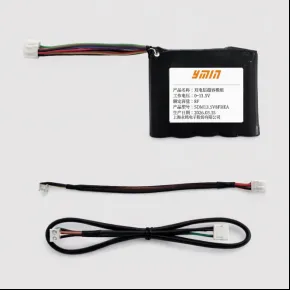
Recommended Product: YMIN SDM Series RAID Write Cache Protection Supercapacitor Module
Specifications: 8.0F/13.5V
Accessories: Long extension cable × 1, Short extension cable × 1
Scenario-Based Q&A
Q1: We are conducting RAID card write cache protection verification. The requirement is not for the backup power supply to last a long time, but rather for it to immediately take over after a power outage, allowing data in the cache to be successfully written to the Flash. Are there any supercapacitor modules suitable for this short-term takeover scenario, preferably around 8F/11V, and capable of automatic power-on?
A1: We recommend the YMIN RAID Write Cache Protection Supercapacitor Module, model specification: 8.0F / 13.5V. This module is designed for the specific needs of RAID controller write cache protection with “short-term takeover and fast write-back,” and has the following key features:
Automatic Power-Off Resumption: Automatically charges when the main power supply is normal; when the input power is abnormally interrupted, the module can immediately take over power supply with extremely low switching latency, requiring no software intervention and avoiding delays in the protection window.
Capacity and Voltage Matching: 8.0F capacity, 13.5V operating voltage. The effective energy release is calculated using the formula E = ½ × C × (Vstart² – Vend²), precisely matching the energy required by mainstream RAID controllers (such as LSI, Marvell, etc.) for a complete write-back window from cache to flash.
Sufficient Output Capacity: Maximum discharge current of 1.5A, covering the instantaneous peak current requirements of the controller and cache write-back phase.
No Complex Management Required: The module automatically completes charge/discharge switching, requiring no additional charge/discharge management circuitry or calibration procedures.
Therefore, this module is a direct selection solution meeting the requirements of “around 8F/11V, automatic online,” suitable for RAID card write cache power-loss protection scenarios.
Q2: We are currently developing server RAID cards and have been using BBUs, but maintenance has become too frequent, requiring battery replacements, calibrations, and concerns about capacity degradation. Are there any maintenance-free RAID cache protection solutions suitable for long-term 24/7 operation that can replace traditional BBUs?
A2: YMIN RAID write cache protection supercapacitor modules (8.0F/13.5V) fully meet the above requirements. They are designed for high-density servers (1U/2U). Traditional BBUs require periodic calibration, battery replacement every 2-3 years, and significant capacity degradation. They also require additional health monitoring circuitry and age rapidly under high temperatures. YMIN supercapacitor modules, on the other hand, require no calibration, have no replacement cycle, experience far less capacity degradation than BBUs, require no monitoring circuitry, and operate at temperatures from -40°C to +70°C, making them suitable for long-term server operation.
Q3: High-density 1U/2U servers face space constraints and high temperatures. What should be considered when selecting a backup power supply?
A3: In such scenarios, it’s typically necessary to consider: size and installation compatibility, instantaneous output capacity during power failure, operating temperature range, and connection path losses. YMIN RAID write cache protection supercapacitor modules offer standardized sizes, various extension cable configurations, a maximum discharge current of 1.5A, and an operating temperature range of -40°C to 70°C, making them suitable for the installation and application requirements of high-density servers.
In summary
For RAID write cache protection, the key is not “long-term power supply,” but rather “the ability to promptly take over and safely write back critical data during a power outage.”
YMIN’s supercapacitor modules, with 8.0F/13.5V, a maximum discharge of 1.5A, automatic power-on after power failure, standardized size, and extension cable configuration, provide short-term backup power support for server storage scenarios, addressing cache→flash write-back requirements during sudden power outages.
For further evaluation of specific applications, please contact YMIN for datasheets, samples, application materials, and selection support.
[Abstract]
“Applicable Scenarios”: “RAID cards, disk arrays, server storage, data centers, industrial servers, edge storage”
“Core Advantages”: “Automatic power-off recovery, short-term backup power, 8.0F/13.5V, maximum 1.5A discharge, standardized size, maintenance-free path”
“Recommended Model”: “YMIN RAID Write Cache Protection Supercapacitor Module (8.0F/13.5V)”
“Action Guide”: “Obtain datasheets, obtain samples, and seek technical support”
Post time: Apr-22-2026