Introduction: The New Generation of SSD Form Factors Places More Stringent Requirements on Capacitor Selection
The new generation of SSD standards—E1.S, E3.S, E1.L, and E3.L—represented by EDSFF (Enterprise and Data Center Storage Form Factor), are rapidly replacing traditional 2.5-inch U.2 and M.2 form factors in high-density data centers, achieving a 2 to 5-fold increase in storage density per server unit. Meanwhile, ultra-thin 5mm SATA drives with U.2 interfaces are widely used as boot drives in 1U/2U servers, with even stricter overall board height limitations.
The storage architecture of AI servers has leaped from “general-purpose reliability” to “AI extreme performance.” The new generation of SSDs must continuously deliver extreme performance under extreme loads and high temperatures, while simultaneously facing the reality of extremely limited PCB space. The selection of PLP (Power-Loss Protection) capacitors has evolved from simply “ensuring basic reliability” to becoming a critical component that “determines the upper limit of performance.”
YMIN offers three representative polymer tantalum capacitor selection solutions for different SSD form factors, meeting the PLP requirements of E1.S/E3.S SSDs (height limit 2.05 mm) and U.2 ultra-thin 5mm SATA boot drives (height limit 1.6mm). This series features a core structural upgrade, replacing the original Panasonic TQS series thinner products (such as the 35TQS47MEU, 7343-1.4mm package), and offering significant advantages in domestic supply and new structural design.
Application Challenges
2.1 Physical Size Constraints: Two Height Limits, Two Major Pain Points
E1.S/E3.S SSDs: Single-sided PCB layout, overall board component height ≤ 2.05mm. Conventional polymer tantalum capacitors generally exceed 2.0mm in height, limiting selection.
U.2 Ultra-thin 5mm SATA Boot Drive: With a drive thickness of only 5mm, the component height is typically ≤1.6mm after double-sided PCB layout. The height of conventional tantalum capacitors is insufficient. Forcibly reducing capacitance or using miniaturized components with high ESR will directly lead to insufficient PLP performance.
2.2 Risk of Data Loss Due to Insufficient PLP Performance
PLP Circuit Core Principle: During normal power supply, the capacitor charges and stores energy through the RC circuit; during power failure, it discharges to provide a millisecond-level working window for the controller and cache to complete the final NAND write. Charging time is affected by the RC time constant and ESR; the higher the ESR, the slower the charging and the less energy stored. In AI server environments with frequent read/write operations and a high probability of abnormal power outages, improper selection of PLP capacitors may cause data loss or even file system corruption.
2.3 Supply Chain and Cost Pressures
Imported brands (such as Panasonic) typically have lead times of over 12 weeks, and prices fluctuate continuously, bringing uncertainty to the project’s mass production ramp-up and making it difficult to meet the localization rate requirements of OEMs. As a domestic capacitor manufacturer, ymin has significant advantages in delivery time response, cost control, and supply chain security.
ymin Technical Solutions
3.1 Recommended Selection Table (Three models, categorized by application scenario)
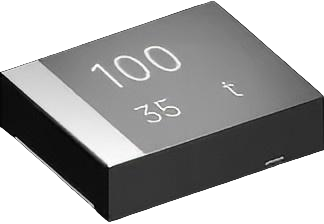
TQW19 35V/100μF 7.3*6.0*1.9mm (bottom terminal package)
| Application Scenario | Recommended Specification | Dimensions (mm) | Key Advantages |
| E1.S/E3.S SSD | TQD19 35V 68µF | 7.3×4.3×1.9 | 1.9mm height, meets height limit requirements |
| E1.S/E3.S SSD | TQW19 35V 100µF | 7.3×6.0×1.9 | 1.9mm height, larger capacitance |
| U.2 Ultra-slim 5mm SATA Boot Drive | TQD15 35V 47µF | 7.3×4.3×1.5 | 1.5mm height, meets height limit requirements for ultra-slim drives |
3.2 Core Technology Advantages
① Highly Precise Adaptation: The TQD19/TQW19 series, with a height of 1.9mm, directly meets the height limitations of single-sided PCB layout for E1.S/E3.S SSDs; the TQD15 series, with a height of 1.5mm, perfectly adapts to U.2 ultra-thin 5mm SATA boot drives.
② Upgraded Core Structure of New Tantalum Capacitors: The terminals are designed at the bottom of the component, significantly shortening the current loop. The ESL (Equivalent Series Inductance) is reduced by approximately 50% compared to traditional structures, resulting in excellent high-frequency characteristics. For cases where the ESR (120mΩ) is slightly higher than Panasonic’s TQS series (100mΩ), YMIN has enhanced high-frequency decoupling capabilities through a bottom terminal design, resulting in better ESL and making it more suitable for high-speed switching transient response scenarios in AI server SSDs.
③ High-Density Polymer Tantalum Core + Thin Packaging: Achieving 68μF/100μF/47μF capacitance and 35V withstand voltage even at extreme heights of 1.9mm/1.5mm, without compromising performance.
④ All-solid-state high-reliability structure: Operating temperature -55℃~105℃, meeting the high-temperature conditions of AI servers 24/7.
3.3 Supply and Localization Advantages
As a domestic capacitor manufacturer, YMIN not only meets product selection requirements in this type of application but also balances delivery efficiency and cost control:
① More flexible delivery response (typically 4-6 weeks), closely aligning with customer project schedules;
② Full-chain localization, meeting the supply chain security and localization rate targets of OEMs;
③ Lower overall implementation cost compared to imported solutions, assisting customers in BOM optimization.
Scenario-based Q&A
Q1: E1.S/E3.S SSDs have a height limit of 2.05mm. Can YMIN provide tantalum capacitors below 1.9mm without reducing capacity?
A1: Yes. YMIN’s TQD19 (68µF) and TQW19 (100µF) are both 1.9mm in height and have a withstand voltage of 35V. Employing a high-density polymer tantalum core and thin packaging, it does not sacrifice capacity or withstand voltage. The bottom terminal design reduces ESL by approximately 50%, resulting in superior high-frequency characteristics compared to traditional structures.
Q2: The ESR of the YMIN TQW19 is 120mΩ, slightly higher than the Panasonic TQS series (100mΩ). Does this affect PLP performance?
A2: In actual PLP circuits, factors affecting charging speed and power-off hold time include not only ESR but also total loop resistance and ESL. YMIN’s bottom terminal design significantly reduces ESL (approximately 50%), improving high-frequency transient response; simultaneously, the wide-body packaging helps reduce contact resistance. This solution has been validated for PLP functionality in multiple AI server SSD customers. Customers are advised to conduct actual board-level verification.
Q3: Does YMIN have a corresponding product for the U.2 ultra-thin 5mm SATA boot drive, which has a height limit of only 1.6mm?
A3: Yes. The ymin TQD15 series is only 1.5mm high, with a 47µF capacitance and a 35V withstand voltage, specifically designed for ultra-thin drive bodies. It also features a bottom-mounted terminal structure, resulting in low ESL and high reliability.
Q4: How much of an advantage does ymin have in terms of delivery time and cost compared to imported brands?
A4: ymin’s standard delivery time is 4-6 weeks, significantly shorter than the 12 weeks or more of imported brands, and its supply stability is high. At the same performance level, it can help customers optimize overall implementation costs while meeting localization rate targets.
Summary
In AI server SSD power-loss protection applications, capacitor selection must consider not only board space limitations but also power-loss protection performance, project implementation efficiency, and supply stability.
ymin polymer tantalum capacitors offer precise selections for different scenarios: the TQD19/TQW19 series (1.9mm height) is suitable for E1.S/E3.S SSDs (height limit 2.05mm); the TQD15 series (1.5mm height) is suitable for U.2 ultra-thin 5mm SATA boot drives (height limit 1.6mm). The products adopt a bottom-mounted terminal structure, reducing ESL by approximately 50% and offering excellent high-frequency characteristics; they are all solid-state, have a wide operating temperature range, and a long lifespan; meanwhile, the advantages of domestic production ensure timely delivery and cost-effectiveness.
If you require actual testing, please contact us to request samples. We will also provide datasheets, test reports, and selection tables.
[Abstract]
“Applicable Scenarios”: “AI servers, M.2 2280 SSDs, height limit 1.9mm, PLP power-off protection”,
“Core Advantages”: “1.9mm height, 100µF/35V, 10% lower total loop resistance than Panasonic, 11.5ms power-off hold-up time (↑60%), 0% data loss rate”,
“Recommended Models”: “TQW101M1VW19120RN, TQW19 35V 100μF 7.3*6.0*1.9″,
“Action Guide”: “Specifications, test reports, selection table, sample application”
Post time: Apr-28-2026