In high-end industrial fields such as military equipment, rail power supplies, and charging piles, equipment is facing increasingly harsh operating environment challenges. Especially in extremely cold regions, low temperatures pose a severe test to the performance of electronic components. Among these challenges, the rapid capacity decay of high-voltage aluminum electrolytic capacitors at low temperatures has become a core pain point leading to equipment startup failures and performance instability.
In-depth Analysis of the Pain Point: Why is Low Temperature the “Nemesis” of High-Voltage Capacitors?
In low-temperature environments, the viscosity of the internal electrolyte in traditional high-voltage aluminum electrolytic capacitors increases, and may even freeze, leading to a sharp decrease in ionic conductivity. This causes the equivalent series resistance (ESR) of the capacitor to soar, and the effective capacitance (CAP) to plummet. Under extreme conditions of -55℃, the capacitance decay of ordinary capacitors can be as high as 45% or even over 76%, meaning that a 100μF capacitor may only have 20μF of usable capacity left, unable to provide sufficient instantaneous energy to the power module, directly causing the equipment to “shut down.”
Yungming Electronics Solutions: LKC Series, Defining a New Standard for Low-Temperature Capacitors
Addressing this industry bottleneck head-on, Yungming Electronics launched the LKC series 450V 100μF capacitors. Their core value lies in overcoming the low-temperature performance bottleneck of high-voltage capacitors, strictly controlling capacitance decay to within 15% at -55℃.
Core Technological Advantages:
Extreme Low-Temperature Resistance: Wide operating temperature range from -55℃ to +105℃, covering all extreme climate zones globally.
High Capacitance Retention: At the extreme low temperature of -55℃, the average capacitance decay is only 11.62%, maintaining an actual capacitance of 85.07μF, far exceeding competitors.
Data Verification:
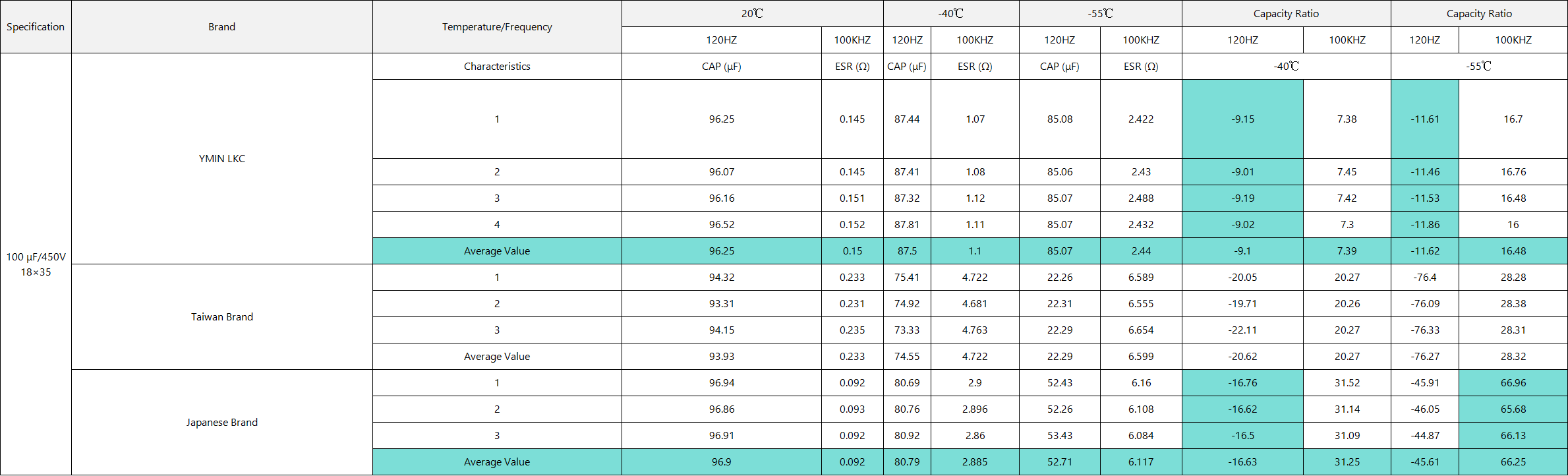
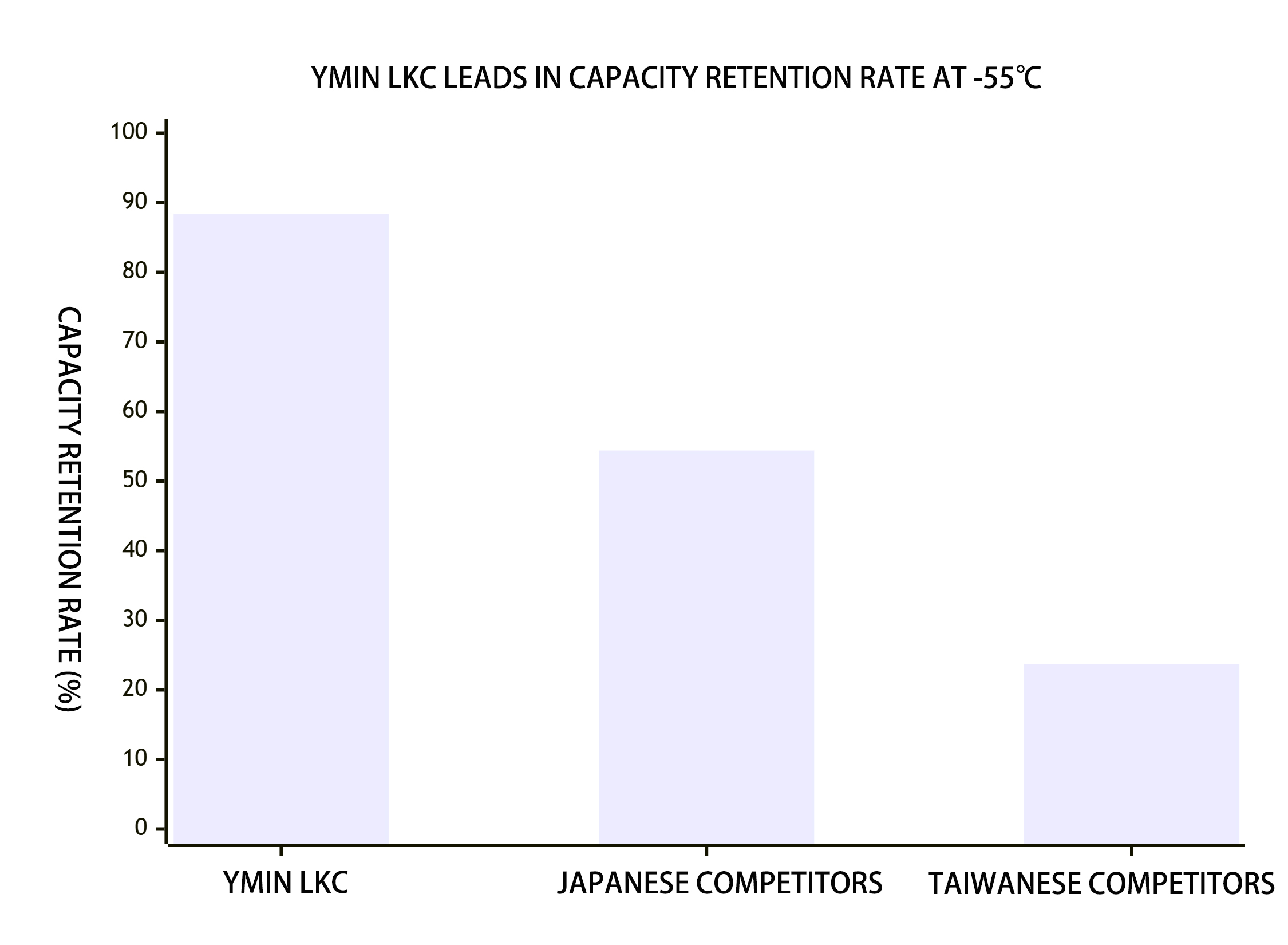
Rigorous laboratory testing has shown that Yung-Ming’s LKC exhibits significantly lower capacity decay (11.62%) at -55℃ compared to Japanese (45.61%) and Taiwanese (76.27%) competitors, with a capacity retention rate nearly 3.7 times higher.
Underlying Strength: Breakthroughs in Materials Science and Precision Manufacturing
This performance leap stems from Yung-Ming’s core technologies:
Exclusive Electrolyte Formula: Utilizing a special low-temperature, high-pressure electrolyte ensures high conductivity even at -55℃, addressing low-temperature performance issues at the material level.
Optimized Structural Design: Innovative internal structural design prevents the electrolyte from freezing at extreme temperatures, maintaining stable capacitor output and achieving reliable capacity decay control.
Typical Applications and Recommended Models
Military Equipment: Provides instantaneous startup and stable operation support at -55℃ for field communication, radar, and other combat readiness equipment.
Railway Power Supply: Ensures smooth startup of auxiliary power supplies (lighting, air conditioning) for trains in high-altitude and cold regions after low-temperature standby.
Charging Stations: Addresses the issue of unstable output power and reduced charging efficiency in DC fast charging stations during winter due to reduced bus capacitor capacity.
Recommended Model: YMIN LKC Series 450V 100μF Capacitor.
Conclusion
Choosing the YMIN LKC series means choosing certainty in extreme environments. We not only provide a -55℃ liquid lead aluminum electrolytic capacitor, but also a reliable solution to overcome the challenges of low-temperature applications, committed to achieving high reliability. For capacitor applications, if you encounter difficulties, turn to YMIN. Let us help your products withstand the cold and operate stably.
Post time: Dec-01-2025